Welcome to my homepage! I translated all the recipes using Google Translate, as my English isn't perfect. So please bear with me if the translation isn't grammatically correct.
Please follow my on FB "Deutsche Brötchen-German Rolls"
I'm someone who enjoys good bread and rolls. Unfortunately, there are very few locally owned bakeries left in Hamburg that don't use baking mixes. I don't use them myself!
I prefer to avoid all the additives that are unfortunately found in most industrially produced breads and rolls. Or why does packaged toast from the supermarket stay fresh for up to two weeks? That's another reason why I don't buy bread or rolls anymore! But it really took me many years to bake usable rolls and breads that were worth it, that could even be called that. When I present my recipes here, it's without claiming that I created them all myself. I'm not that creative, but I usually adapt the recipes to suit my needs. I'm very grateful for the inspiration that Marcel Paa, Ploetzblog, the Brotdoc, Ketex, Hefe&mehr, a few Danish YouTubers, and many, many others give me.
A frank word about baking enzymes
Baking enzymes: You can leave them out if you have concerns or they're unavailable.
Baking enzymes accelerate the biochemical processes during bread baking, convert starch into sugar for the yeast, and improve dough structure and elasticity, as well as the crust color. The rolls simply rise better!
After baking, the enzymes are no longer detectable.
Only after I discovered baking enzymes for my own use did I actually bake bread and rolls of bakery quality.
I get my baking enzymes online in Denmark. In the US, they're probably also available on Amazon.
How can I substitute the flours I commonly use in Germany in the US?
Manitobamehl = Flour with a very high protein content of 13-14%
Weizenmehl 550 = All-purpose flour
Weizenvollkornmehl = Whole wheat flour
My favorite breads
- My Sourdough - Potato Sandwichbread
- My Toast / Sandwich
- BreadWhole-grain toast
- Whole Wheat Toast
- Baguette like in France
- Whole Wheat Toast with Flaxseed
- Sauerkraut Bread with Mustard Seed Crust
- Focaccia
- Grain by Grain, My Black Bread
- Walnut Chiabatta
- Poller bread
- Hamburger Klöben (Raisin Bread)
- Spelt Whole Wheat Bread with Seeds
- Spelt Toast
My favorite Rolls
- Rustic Ryerolls
- Potato-Cheese Rolls
- Potato- Sesam Rolls
- Potato- Creamcheese Rolls
- Blueberry Bagel
- jalapeño-Tomato-Cheese Bagel
- Sauerkraut-Potato Rolls mit Mustard Crust
- My "Power Sticks" – Healthy Seed-Coated Sticks
- Bananabread Bagel
- Potato "World-Champion" Rolls
- My Pretzel Roll Sticks
- German Pretzel Rolls
- My Alster - Krüstchen (Cracked - Crust Rolls)
- Osnabrück "Springbrötchen" (Cracked - Crust Rolls)
- My danish Butter Rolls
- Danish beer rolls with flax seeds
- Chia seed crusties
- Apple and carrot rolls with rolled oats
- Poppy seed and sesame seed rolls with 3-stage sourdough
- Hamburg Rolls
- Baguette Rolls
- American Bagel with Sourdough
- My Danish Poppy Seed and Sesame Rolls
- my quick Potato Rolls
- Potato and Herb Rolls
- My Onion Rolls
- Pandesal, Filipino Soft Rolls
- Hamburger Franzbrötchen
- My Rye Rolls
- My Danish Beer Sticks
- Tiger Rolls
- My Hamburger Rounds
- Raisin Rolls
- New wholemeal bread rolls
- Kiel rolls
- Somit- " my türkisch Rings
- Fried Potato Rolls new in December
- Worldchampion Potato Rolls new in December
- Danish Tebirkes, Danish Split Rolls
- Potato Rolls with Sourdough
- Korneck, Corn Corners
- Hamburger Krause Klöben
- Sliced Rolls with Spelt
- Healthy Whole Wheat Rolls
- Mine World Champion
- Danish Yogurt Seed Rolls
- Power Seed Rolls
- Rolls with Ricotta, Bacon, and Onions
- Danish Sesame Rolls
- World's Best Hot Dog Roll, Promised
- Sweet Potato Buns
My Breads
My Sourdough- Potato Sandwichbread
I already think my "standard" toast breads are very good, but the potato toast is in a league of its own.
It combines the lightness of classic wheat toast with the moistness and rustic character of potato bread.
Compared to wheat toast, the crumb is slightly denser but remains very springy and fine-textured.
Thanks to the potato content, the surface caramelizes beautifully and evenly when toasted. While the outside develops a wonderfully crisp, golden-brown crust, the center of the loaf stays wonderfully soft and moist; it doesn't dry out in the toaster as quickly as standard toast.
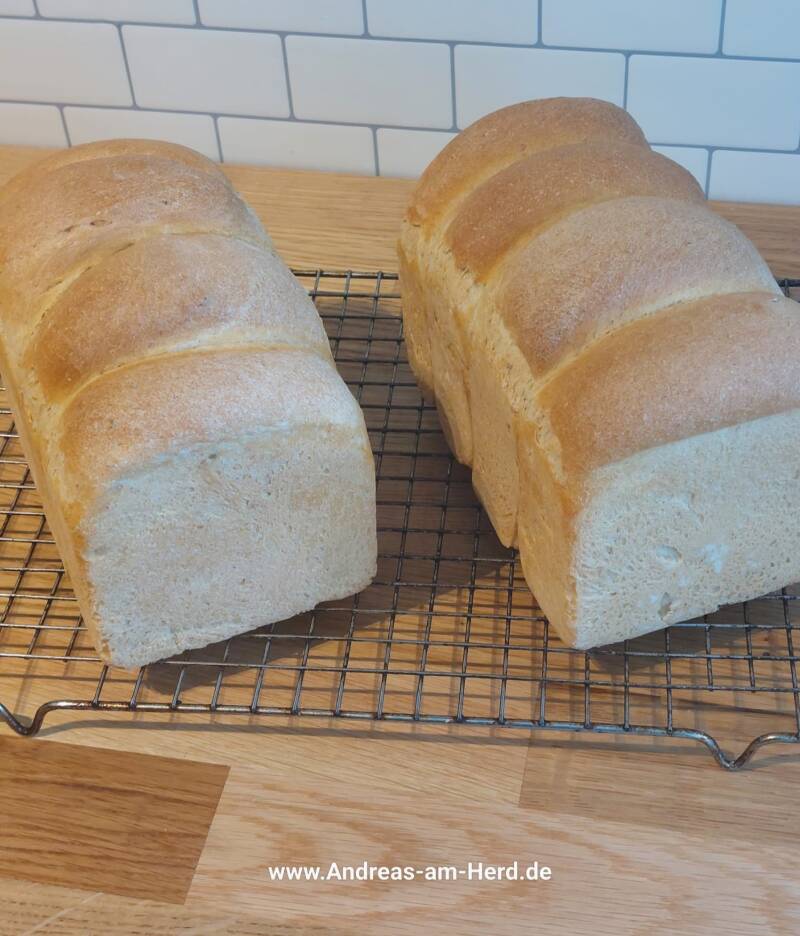
Pre-dough: 100 g Manitoba flour, 1 g dry yeast, 100 g cold water.
Sourdough: 50 g Levito Madre, 50 g warm water, 50 g Manitoba flour.
Scalded flour mixture: 40 g Manitoba flour, 120 g boiling milk.
Main dough:
- 300 g Type 550 wheat flour,
- 60 g Manitoba flour,
- 150 g cooked and mashed potatoes,
- 10 g baking enzymes (optional),
- 5 g dry yeast,
- 25 g apple cider vinegar,
- 20 g honey,
- 14 g salt,
- 25 g butter
- Mix the dry ingredients.
- Work everything into a soft dough.
- Add the salt after approx. 5 minutes.
- Once the dough pulls away completely from the sides of the bowl, knead in the butter.
- Place the dough in a container and let it rest for approx. 90 minutes; stretch and fold every 30 minutes.
- Degas the dough and divide it into 5 equal pieces. Shape into balls and place in the loaf pan.
- When the dough has risen to the rim of the pan, preheat the oven to 230°C (top/bottom heat).
- Place the loaf pan in the oven and generate plenty of steam; reduce the temperature to 185°C.
- Baking time: 38 minutes.
My Favorite Toast & Sandwich Bread
This is our absolute favorite bread! I bake it at least once a week. I don't want to brag, but I think it's truly one of the best things I've ever baked.
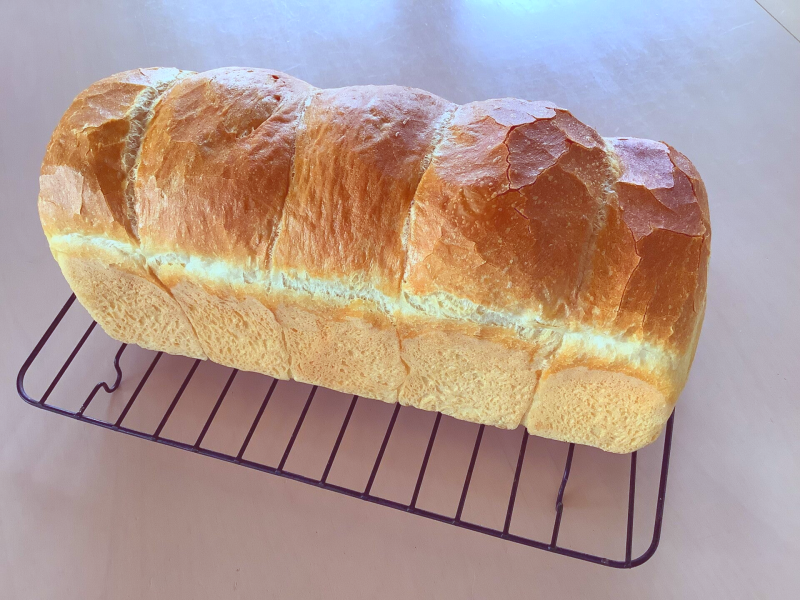
Ingredients:
- 350 g Manitoba flour
- 200 g 550 wheat flour
- 30 g Levito madre
- 1o g baking enzymes
- 8 g dry yeast
- 280 g cold water
- 50 g milk
- 11 g salt
- 15 g apple cider vinegar
- 20 g softened butter
Aurolysis dough:
Lightly knead the flour with the baking enzyme, water, and milk. This allows the flour to expand slightly. Let stand for 60 minutes.
Then add the remaining ingredients, except the salt and butter, and knead everything into a
soft dough. After 5 minutes of kneading, add the salt and knead until the dough completely pulls away from the sides of the bowl.
Knead in the butter in small pieces. When the dough starts to pull away from the sides of the bowl, transfer it to a lightly oiled dough bowl. Let it rise for 60 to 90 minutes, stretching and folding every 30 minutes.
Then transfer the dough to a lightly floured work surface. Degas and divide it into 5 equal pieces. Roll them into rounds and place them in a 30 cm loaf pan. Cover and let rise until the dough reaches the edges of the pan.
In the meantime, preheat the oven to 250°C (fan/convection oven), place the loaf pan in the oven, add steam, and reduce the temperature to 180°C (350°F).
Bake for 35 minutes.
Wheat Toast- and Sandwich Bread

This recipe is intended for a 30 cm loaf pan.
Boiled dough:
- 30 g 550-grade wheat flour
- 100 g milk
Bring the flour and milk to a boil in a small saucepan, stirring constantly.
When a pudding-like consistency has formed, transfer the boiled dough to a small bowl,
cover with foil, and let cool.
Pre-dough:
- 100 g 550-grade wheat flour
- 1 g dried yeast
- 100 g cold water
Prepare the pre-dough the evening before. Let it rest for approximately 12 to 16 hours.
The next day,
Main Dough:
Cooking dough and pre-dough
- 35 g Levito madre
- 325 g Manitoba flour or 550 wheat flour
- 75 g whole wheat flour
- 10 g baking enzymes or malt
- 140 g cold water
- 1 egg, size L -
- 13 g salt
- 6 g dry yeast
- 25 g apple cider vinegar
- 30 g butter
Mix all together and Knäckebrot It for a smooth, not sticky dough.
Cover the dough and let it rise at room temperature for about 2 hours.
Stretch and fold it twice.
Place the dough on a floured work surface, divide it into 5 roughly equal pieces,
and roll them into rounds.
Place the dough in a greased 30 cm loaf pan and press firmly.
Let it rise, covered, for another 60-90 minutes.
Preheat the oven to 180°C and bake the bread with steam for about 40 minutes.
These Baguettes are like in France
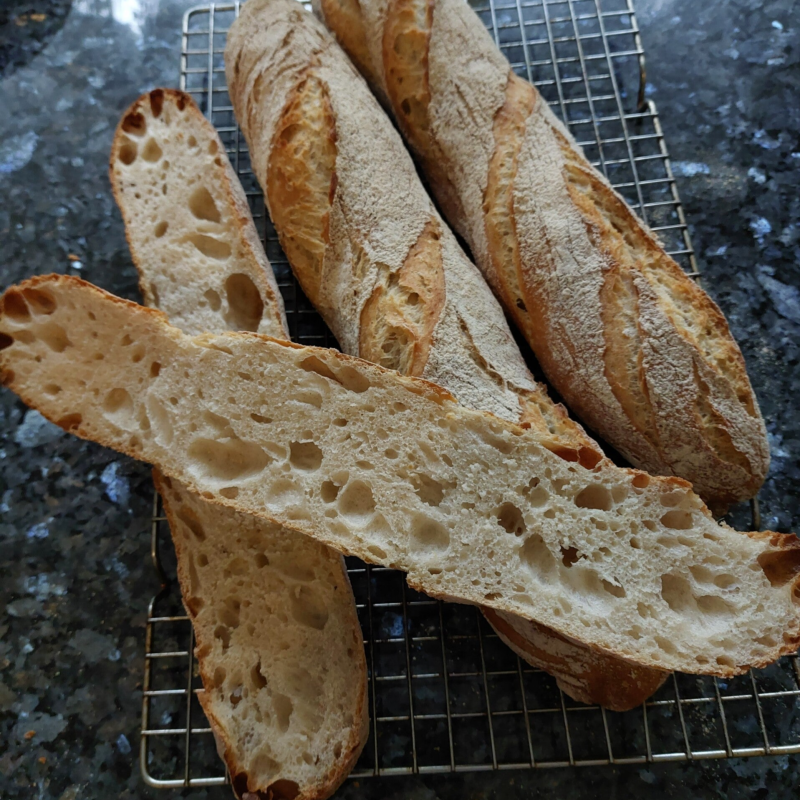
Recipe for 3 Baguettes
Pre-dough
- 150 g 550-grade all-purpose flour
- 150 g water
- 1 g dry yeast Sourdough
- 50 g Levito Madre
- 25 g water
- 6 g honey
- 100 g rye flour
Main Dough
- Sourdough - Pre-dough
- 360 g 550-grade all-purpose flour
- 220 g water
- 11 g baking enzymes
- 3 g dry yeast
- 12 g salt
40 g water, to be added later
Mix all ingredients, except the 40 g water and salt, into a smooth dough. After about 3 minutes, add the salt.
If necessary, knead in the 40 g water towards the end of the kneading time.
Place the dough in a dough bowl and let it rise for about 2 hours. Stretch and fold it 2-3 times.
Then refrigerate until the next morning.
The next morning, remove the dough from the refrigerator and let it acclimatize for 1 hour.
Divide the dough into 3 equal pieces on a well-floured work surface.
First, shape it into a round, then carefully lengthwise.
Let it rise in a well-floured linen cloth, seam down, for 45 minutes.
Meanwhile, preheat the oven to 250°C (fan/convection oven).
Carefully turn the dough pieces over and place them on a baking sheet lined with parchment paper.
Moisten with water and bake with plenty of steam for about 20 minutes.
My Whole Wheat Toast with Flaxseeds
This toast/sandwich bread is my absolute favorite, which I bake twice a week.
It easily stays fresh for four days, if it hasn't been eaten before then. It's very soft and fluffy.
Unlike commercial bread, this one uses real butter, not clarified butter, and fresh milk, not skim milk powder.
The apple cider vinegar makes the bread so wonderfully airy! Give it a try;
It can be modified in many ways! Instead of flaxseeds, you can use any kind of seeds.
Or simply enjoy it plain, without any seeds.
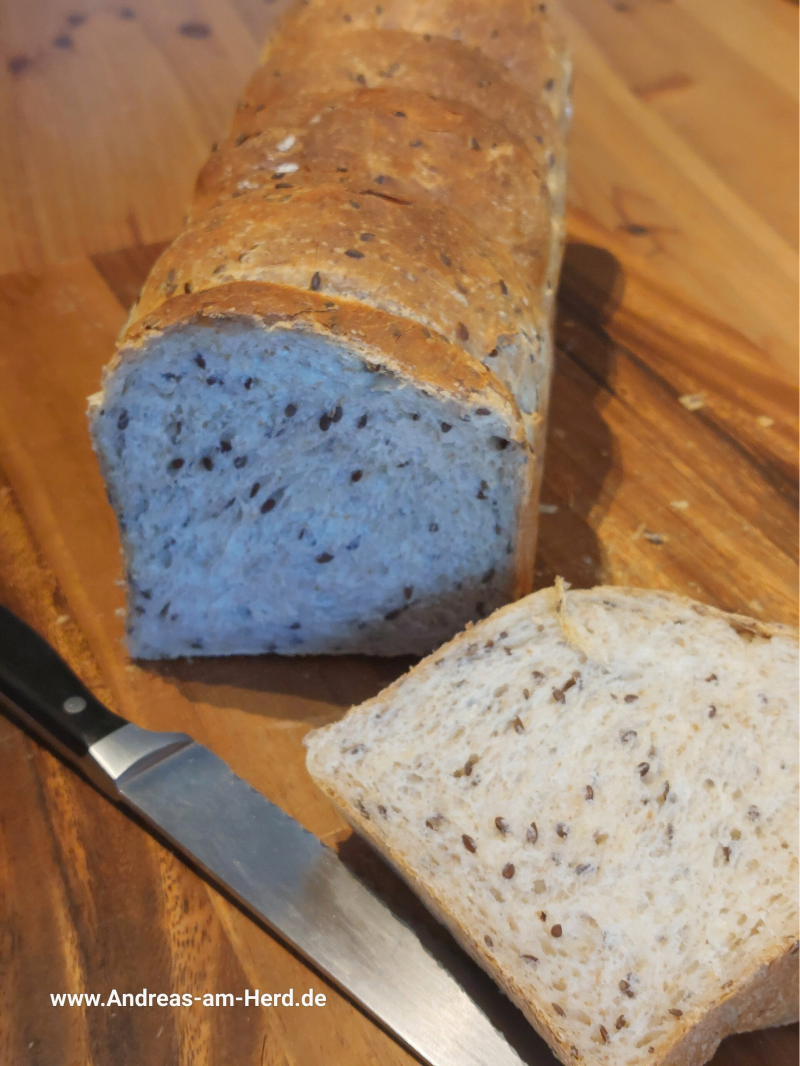
Pre-dough
- 100 g whole wheat flour
- 1 g dried yeast
- 5 g honey
- 100 g water
Cooking dough
- 35 g 550 wheat flour
- 100 g whole milk
Slowly heat the flour and water in a small saucepan, stirring constantly, until a pudding-like consistency forms. Transfer to a small bowl and cover with plastic wrap.
Prepare both the night before and let stand in the kitchen for 12-15 hours.
Main Dough
- 250 g Manitoba Flour
- 200 g 550 Wheat Flour
- 40 g Flaxseed
- 6 g Dried Yeast
- 12 g Salt
- 11 g Baking Enzymes or Malt
- 50 g Levito Madre
- 60 g Water
- 150 g Water
- 25 g Apple Cider Vinegar
- 25 g Butter
Mix all dry ingredients except the salt.
Mix the pre-dough, the cooking powder, the milk, and the apple cider vinegar into a dough, adding the salt after about 3 minutes. Knead for about 10 minutes, adding a little water if the dough seems too dry. Shortly before the end of the kneading time, add the butter in small pieces.
Place the finished dough in a lightly oiled dough pan and let it rise for about 90 minutes. Stretch and fold twice.
Divide the risen dough into 5 equal pieces, roll them into rounds, and place them in a greased loaf pan.
Proving time: approximately 90-120 minutes.
Preheat the oven to 250°C, place the loaf pan in the oven, reduce the temperature to 210°C, and bake with plenty of steam for approximately 40 minutes. After 20 minutes, open the oven door briefly to release the steam.
Sauerkraut Bread with Mustard Seed Crust
When I saw this recipe online, I couldn't believe it. Sauerkraut in the dough, then thickly spread mustard on the dough. That can't possibly taste good.
Now I'm curious. My wife didn't believe the recipe either.
Thank goodness we were both wrong. The result was a truly amazing bread. Super crispy, with a wonderful aroma.
It's now my new favorite bread!

Pre-dough:
- 100 g rye flour (997 or 1150)
- 1 g dry yeast
- 100 g water
Prepare the pre-dough in the afternoon and let it stand, covered, in the kitchen for 12-18 hours.
Cooking dough:
- 30 g wheat flour
- 100 g boiling water
In the morning, prepare the cooking dough and the pre-dough.
Main dough:
- 160 g Levito Madre
- 100 g water
- 200 g wheat flour (550)
- 100 g rye flour (997 or 1150)
- 100 g whole wheat flour
- 10 g baking enzymes
- 12 g salt
- 8 g honey
- 80 g sauerkraut
- 1 tbsp. oil
Knead all ingredients in a food processor until a dough forms, about 10 minutes.
Place the dough in a dough pan and let it rise for 2 hours, stretching and folding it 3 times in between.
Then place the dough in the refrigerator for 12 to 18 hours.
- On the day of baking, remove the dough from the refrigerator and let it acclimatize for 1 1/2 to 2 hours.
- Divide the dough into 2 equal pieces, roll them into rounds, spread with mustard, and roll in seeds.
- Let it rise in a proving basket for 50 to 60 minutes.
- Preheat the oven to 230°C using a cast iron pot.
- Place the dough on parchment paper and place it in the hot pot. Cover the pot, place it in the oven, and bake for about 15 minutes.
- Remove the lid after about 15 minutes. The bread should have risen well, but still needs some color.
- Bake uncovered for about 30 to 35 minutes.
Focaccia
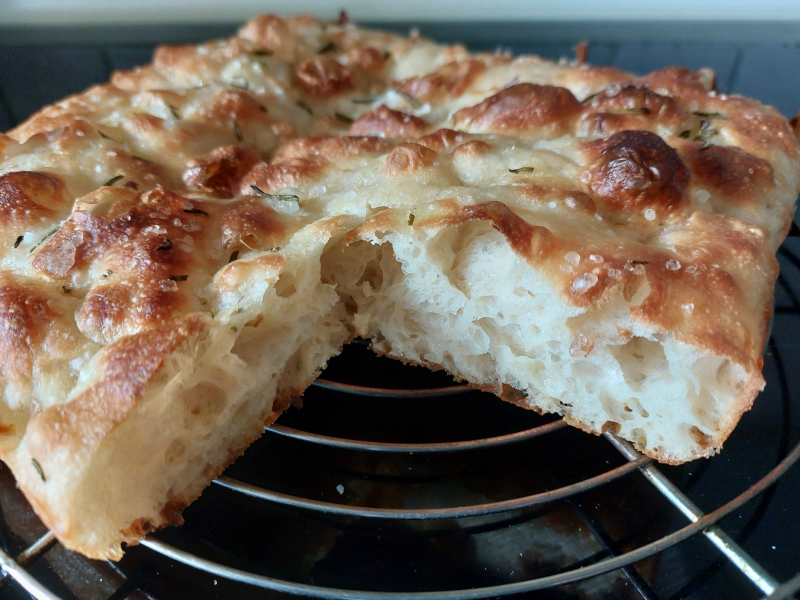
450 g Manitoba flour or 550 wheat flour
- 400 g cold water
- 3 g dry yeast
- 10 g salt
Mix the ingredients in a bowl until you have a very runny dough.
Pour plenty of olive oil into a baking dish, pour in the runny dough, and let it stand, covered, in the kitchen for about 2 hours. Stretch and fold it twice with wet fingers. Then refrigerate it for up to 48 hours. This will allow the dough to develop a lovely aroma.
On the day of baking, remove the dough from the refrigerator, dip your fingers in olive oil, and press deep indentations into the dough. This will create large bubbles on the dough. Be careful not to crush them. Sprinkle with coarse sea salt and rosemary, if desired.
Preheat the oven to 220°C (fan/convection oven) and bake the focaccia for about 20 minutes.
Grain by grain, my brown bread
Here's something very healthy! It's also suitable for people who can't tolerate flour due to allergies, because this bread is baked without wheat flour! The brown bread is super moist. It consists only of sourdough, rye meal, kernels, and seeds. It's a bit more time-consuming to make, due to the waiting time, but it's actually quite simple, and it stays fresh for a very long time.

Morning around 8:00 a.m.
Sourdough:
- 100 g Levito mamma
- 100 g warm water
- 130 g rye meal
- 30 g sugar beet syrup
Grain mix:
- 150 g 5-grain flakes
- 100 g sunflower seeds
- 50 g spelt seeds
- 50 g pumpkin seeds
- 50 g sesame seeds
- 50 g golden linseed, or 50 g more linseed if desired
- 50 g linseed
- 12 g salt
- 500 g boiling water
Evening around 6:00 p.m.:
Mix everything well and pour into a lightly oiled loaf pan. Press down firmly, then cover and let it mature in the refrigerator for 12-18 hours.
On baking day, place the bread in a cold oven and bake at 200°C for 75 minutes. After 60 minutes, remove the bread from the pan and bake for another 15 minutes.
Wait 24 hours after the bread comes out of the oven before slicing.
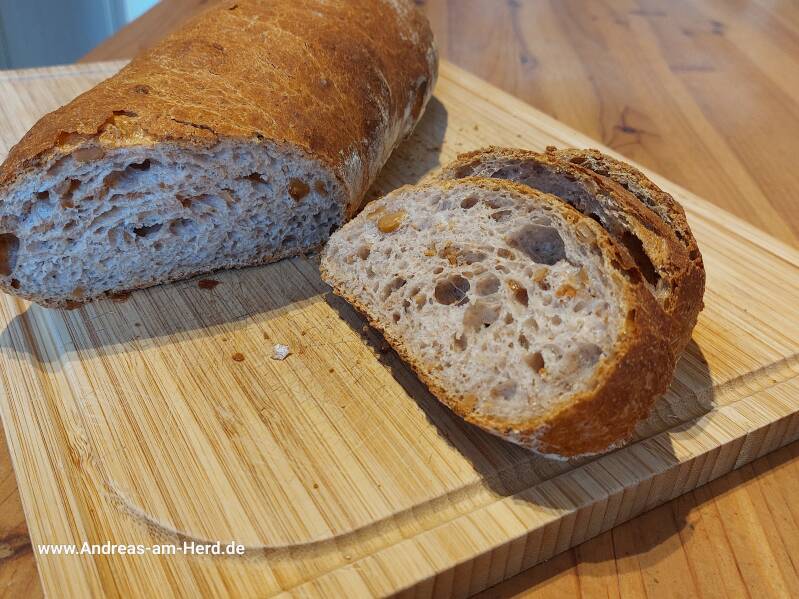
Walnut Chiabatta
Here's a particularly delicious ciabatta made according to an Italian recipe. With plenty of nuts and a generous portion of whole wheat flour, along with my Levito Mamma.
Goes great with cheese and cold cuts.
Biga
- 120 g 550 wheat flour
- 60 g lukewarm water
- 1 g dry yeast
Knead everything together and let stand, covered, for about 24 hours.
Main dough:
- Roast 120 g walnuts in the oven at 180°C for 10 minutes, cool, and chop slightly.
- All the biga
- 300 g wheat flour (Caputo cuoco)
- 80 g whole wheat flour
- 270 g cold water
- 50 g Levito mamma (white flour)
- 15 g baking malt
- 5 g dry yeast
- 10 g salt
- 20 g walnut oil
- 20-40 g extra water
Preparation:
Mix all ingredients, except the walnuts and the extra water, into a smooth dough.
Preparation:
Mix all ingredients, except the walnuts and the extra water, into a smooth dough. The extra water is added a spoonful at a time at the end of the kneading time. The dough must have completely absorbed the water each time.
At the very end, mix in the walnuts.
Place the dough in an oiled dough pan and let it rise, covered, for 1 hour.
Then place the dough on a floured work surface, divide it into 2 pieces, and carefully shape it into a loaf to prevent the air from escaping.
Place it in a floured linen cloth and let it rise for about 45 minutes.
Preheat oven to 250°C, add the bread, and bake with plenty of steam at 210°C for about 20 minutes. Then release the steam and bake for another 20 minutes.
Let it cool and enjoy.
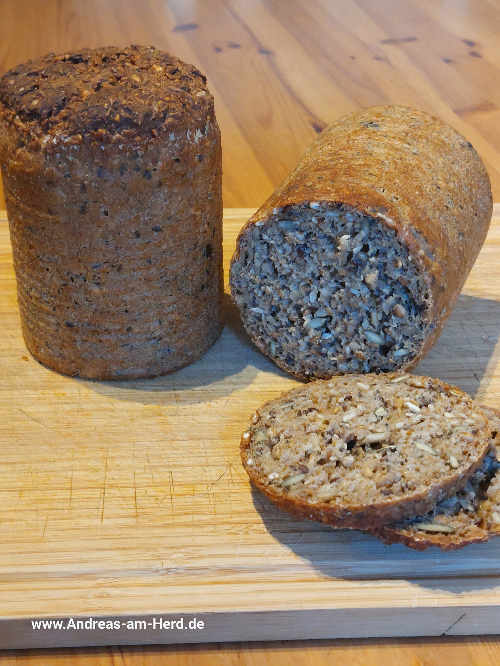
The Poller Bread
The name comes from the word "bollard" (or "poller"), and its shape is reminiscent of the bollards to which ships are moored in the port of Hamburg.
A very moist, delicious whole-grain spelt bread that stays fresh for a long time.
I baked these two beauties in empty sauerkraut cans (they are not coated on the inside). Before baking, you need to line the bottom and sides of the cans with parchment paper.
Stainless steel Poller Bread pans are also available, and you can also buy them online.
Morning
Sourdough:
- 100 g Levito madre
- 100 g warm water
- 150 g wholemeal spelt flour
- 40 g sugar beet syrup
Grain mix:
- 150 g five-grain flakes
- 100 g sunflower seeds
- 50 g spelt seeds
- 50 g pumpkin seeds
- 50 g sesame seeds
- 50 g golden linseed, or 50 g more linseed if needed
- 50 g linseed
- 3 g dried yeast
- 12 g salt
- 400 g boiling water
Afternoon
Mix everything well and pour into two empty pans, which must be lined with baking paper. Otherwise, the loaves might not come out of the pan. Press down firmly and then cover and let rise until doubled in size. Place the bread in a cold oven and bake at 180°C (top and bottom heat) for 90 minutes.
Turn off the oven, carefully remove the bread (while still hot) from the pan, and let it cool in the turned-off oven.
Wait 24 hours after removing the bread from the oven before slicing.
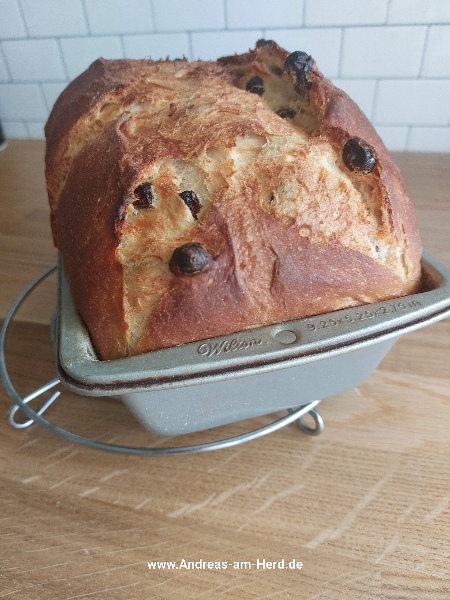
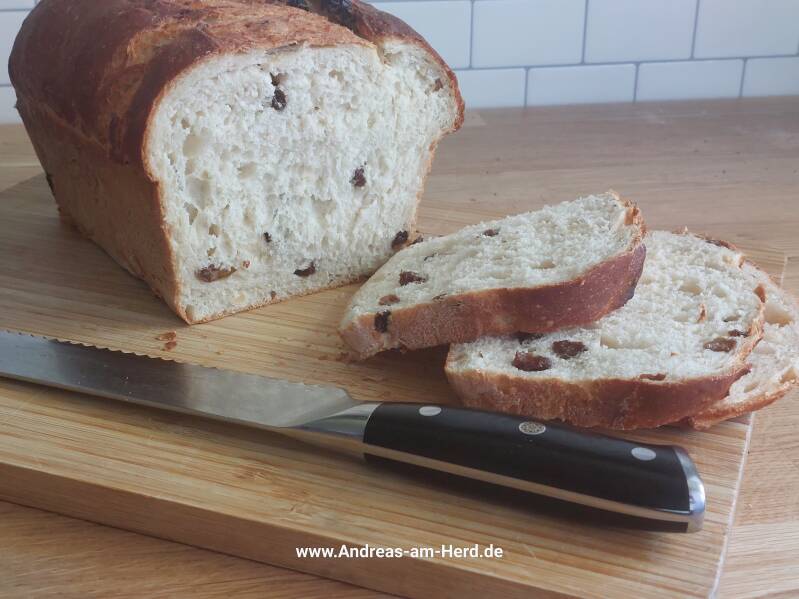
My Hamburg Klöben, Raisin bread
a specialty from my hometown of Hamburg. Very soft dough, fruity, and moist thanks to the sultanas.
Simply delicious! And not just at Easter.
Pre-dough:
- 100 g 550-grade wheat flour
- 1 g dried yeast
- 100 g cold water
Sourdough:
- 30 g Levito madre
- 70 g very warm water
- 100 g 550-grade wheat flour
Prepare both doughs the night before.
Cooking dough:
- 30 g 550-grade wheat flour
- 100 g 3.8% milk
Boil the milk and flour together, stirring continuously, until the mixture has a pudding-like consistency. Allow to cool completely before further processing.
- Soak 80 g sultanas in 150 g water.
On the day of baking:
Drain the sultanas and pat them dry with a paper towel.
For the main dough:
- 220 g 550 wheat flour
- 10 g salt
- 40 g sugar
- 7 g dried yeast
- 10 g baking enzymes
- 1 large egg
- 15 g apple cider vinegar
- 30 g softened butter
Mix all the dry ingredients for the main dough.
Then add the pre-dough mix, the egg, and the apple cider vinegar and
knead into a relatively soft dough.
Knead for approximately 15 minutes, then knead in the butter in small pieces.
Place the finished dough in a lightly oiled dough bowl, flatten slightly, and scatter the dried sultanas over it. Fold the dough several times to ensure the sultanas are evenly distributed throughout the dough.
Let the dough rest for 60-90 minutes, stretching and folding it three times.
When the dough has almost doubled in size, transfer it to a floured work surface.
Stretch the dough slightly and roll it up several times on all sides to give it some tautness.
Place the dough in a suitable baking pan and let it rise for 45-60 minutes.
Meanwhile, preheat the oven to 180°C (fan/convection oven).
Brush the surface with milk and bake with plenty of steam.
Release the steam after 10 minutes.
Bake for 35 minutes.
Feedback geben
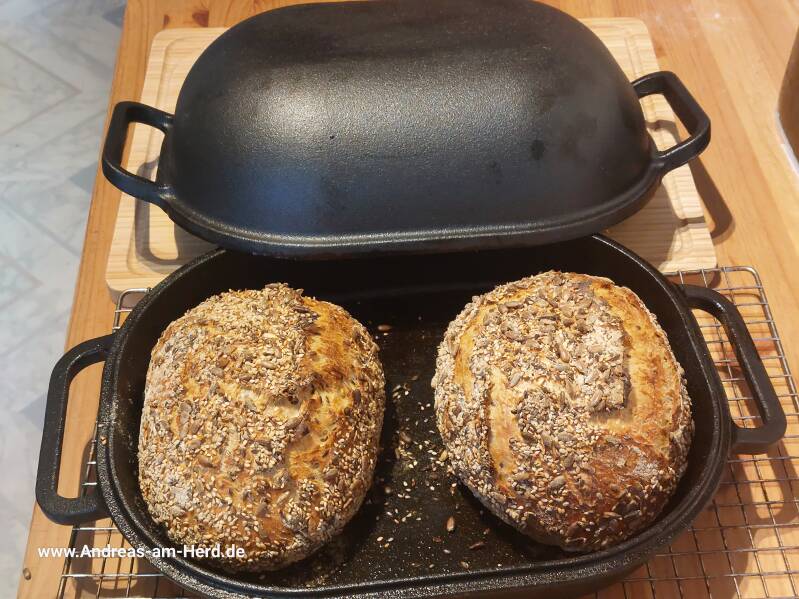
Spelt - Wheat Bread with seeds
My current favorite Dutch oven bread.
A truly delicious bread with a firm crust and a deliciously fragrant crumb. Simply wonderful.
Ingredients
- 300 g spelt flour (630)
- 150 g wheat flour (1050)
- 50 g wholemeal wheat flour
- 100 g seeds (sunflower seeds, sesame seeds, flax seeds)
- 25 g oat flakes
- 30 g sourdough starter
- 2 g dried yeast
- 10 g baking enzymes
- 13 g salt
- 35 g yogurt
- 375 g water
Seed mix:
Sunflower seeds, poppy seeds, sesame seeds, flax seeds
Mix all ingredients except the salt into a soft, slightly sticky dough. After 5 minutes, add the salt and knead gently. Place the dough in a lightly oiled dough pan and let it rise for 90 minutes. Stretch and fold every 30 minutes.
Refrigerate the dough for 24 to 48 hours. On baking day, remove the dough from the refrigerator and let it acclimatize for 2 hours.
Divide the dough into 2 equal pieces, roll them into rounds, and roll them in the seed mixture. Let them rest in a well-floured dough cloth for about 40 minutes.
Meanwhile, preheat the oven to 250°C with the bread pan in it. Place the loaves in the hot pan with the seam facing up. Bake at 220°C for about 45 minutes. After 25 minutes, remove the lid and continue baking for about 15 minutes until the loaves reach the desired browning.
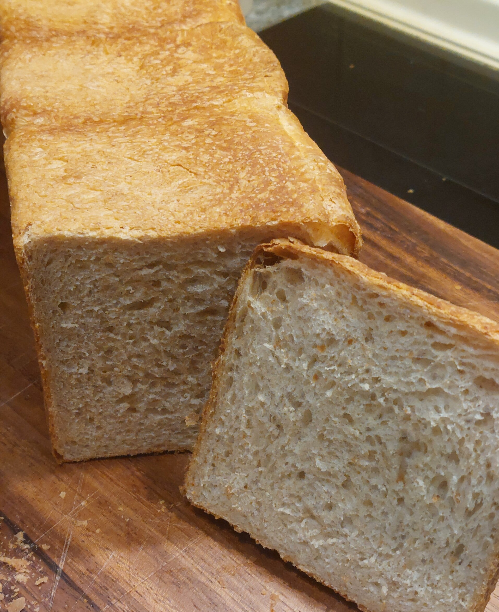
Spelt whole-grain toast
This spelt toast is super delicious and stays fresh for a long time thanks to the cooking piece.
It also tastes great as a sandwich bread without toasting.
Sourdough:
- 30 g Levito mamma (Mamma flour)
- 70 g warm water
- 130 g 630-grade spelt flour
Pre-dough:
- 100 g 630-grade spelt flour
- 100 g cold water
- 1 g dry yeast
Pre-dough:
- 100 g 630-grade spelt flour
- 100 g cold water
- 1 g dry yeast
Pre-dough:
- 12-18 hours, covered, in the kitchen.
Cooking dough:
- 30 g 630-grade spelt flour
- 100 g milk
Bring the flour and milk to a boil in a small saucepan, stirring continuously until a pudding-like consistency develops. Transfer to a small bowl, cover, and refrigerate to cool.
On the day of baking
Main dough:
The pre-doughs
- 290 g 630 spelt flour
- 70 g milk
- 1 egg
- 13 g salt
- 6 g dry yeast
- 10 g baking enzymes or malt (can be omitted)
- 30 g butter
(For a whole-grain version, replace the 630 spelt flour in the sourdough, cooking dough, and main dough with 1050 spelt flour.
Make the pre-dough with whole-grain spelt flour.)
On the day of baking, knead the pre-doughs with the remaining ingredients
in about 15 minutes until you have a smooth dough.
Place the dough in a lightly oiled dough pan and let it rise for about 60-90 minutes. Stretch and fold it twice.
Place the dough on a floured work surface, divide it into 5 equal pieces, and roll it into rounds.
Place them in a greased loaf pan and press down firmly.
Cover and let rise for 90 to 120 minutes.
Preheat oven to 220°C (fan/convection).
Place the loaf pan in the oven.
Reduce the temperature to 180°C (350°F).
Bake the bread with steam for about 35 - 40 minutes.
My Favorite Rolls
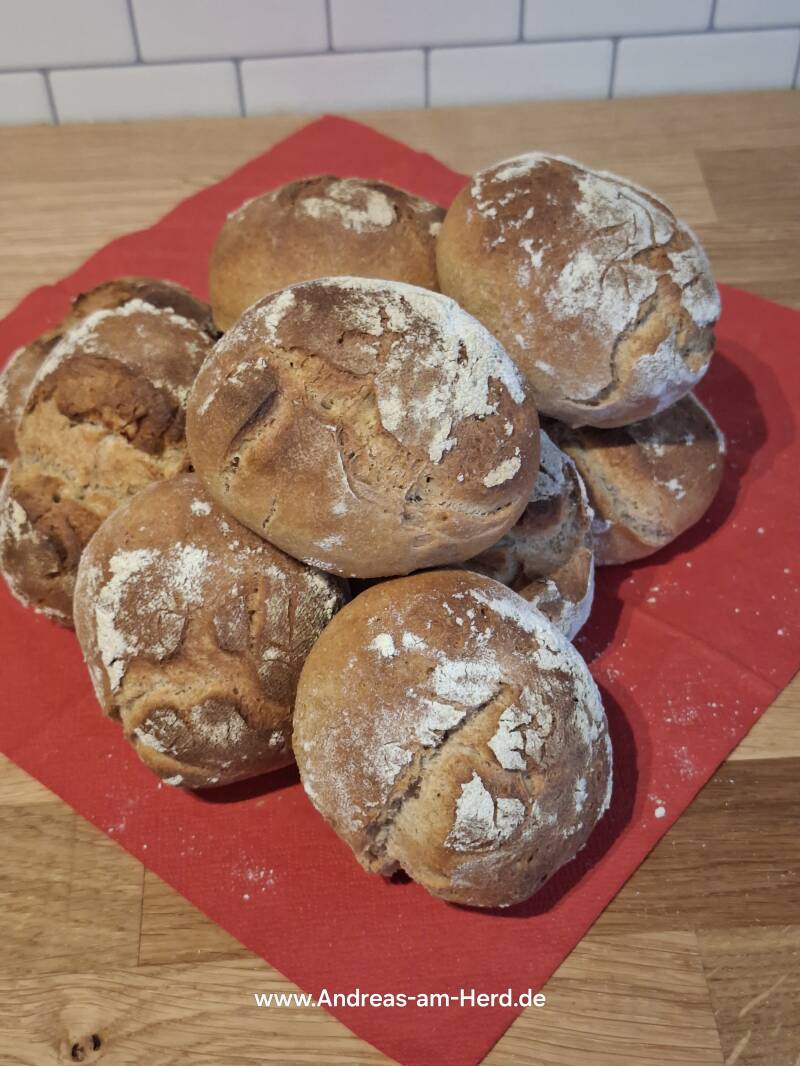
My Rustic Ryerolls
These rye rolls are hearty, robust baked goods featuring a thick, flour-dusted crust and a moist crumb. They contain a high proportion of rye flour and sourdough. They have a rich, nutty flavor, and their surfaces crack irregularly during baking.
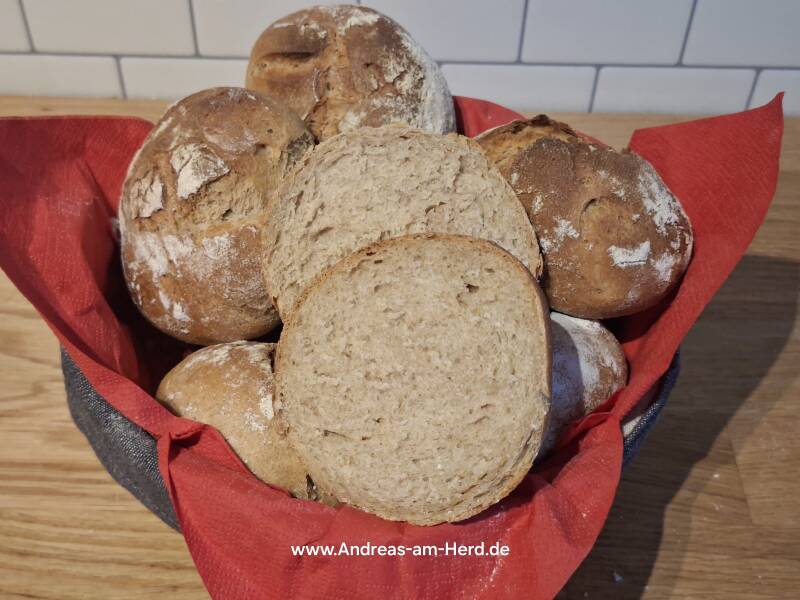
Ingredients for 11 rolls (95 g each)
Sourdough starter: 50 g Levito Madre, 50 g warm water, 50 g Manitoba flour.
Pre-dough: 100 g Manitoba flour, 1 g dry yeast, 100 g cold water.
Prepare the pre-dough and sourdough starter; cover and let them ferment for 8–10 hours or overnight.
Main dough:
- Sourdough starter and pre-dough
- 300 g rye flour (Type 997)
- 200 g Manitoba flour
- 10 g baking enzymes (optional)
- 2 g dry yeast
- 30 g cold water
- 150 g buttermilk
- 12 g salt
- 1 tbsp sugar beet syrup
- 25 g lard
Main dough:
- Place all dry ingredients in the mixing bowl and mix lightly. Add the pre-dough, sourdough starter, buttermilk, and syrup.
- Reserve a portion of the water (bassinage technique) to add later.
- Knead everything into a soft dough for approx. 8 minutes; knead in the lard.
- Place the dough in a lightly oiled container and let it rise for 60 minutes. Perform a stretch-and-fold after 30 minutes.
- Place the container in the refrigerator for cold fermentation.
On baking day:
- Remove the dough from the refrigerator and let it come to room temperature.
- Degas the dough on a lightly floured work surface and divide into equal-sized pieces.
- Shape into rounds, ensuring the seam remains at the bottom. - Place seam-side down on a floured baker's cloth and let rise, covered, at 30°C for 60 minutes.
- Carefully turn the pieces of dough over and place them on a baking sheet lined with parchment paper.
- Bake with steam at 250°C (top and bottom heat) for 10 minutes, then reduce the temperature to 220°C and bake for another 8–10 minutes.
- Let cool on a wire rack.
Greek Tomato - Feta - Thyme Bagel
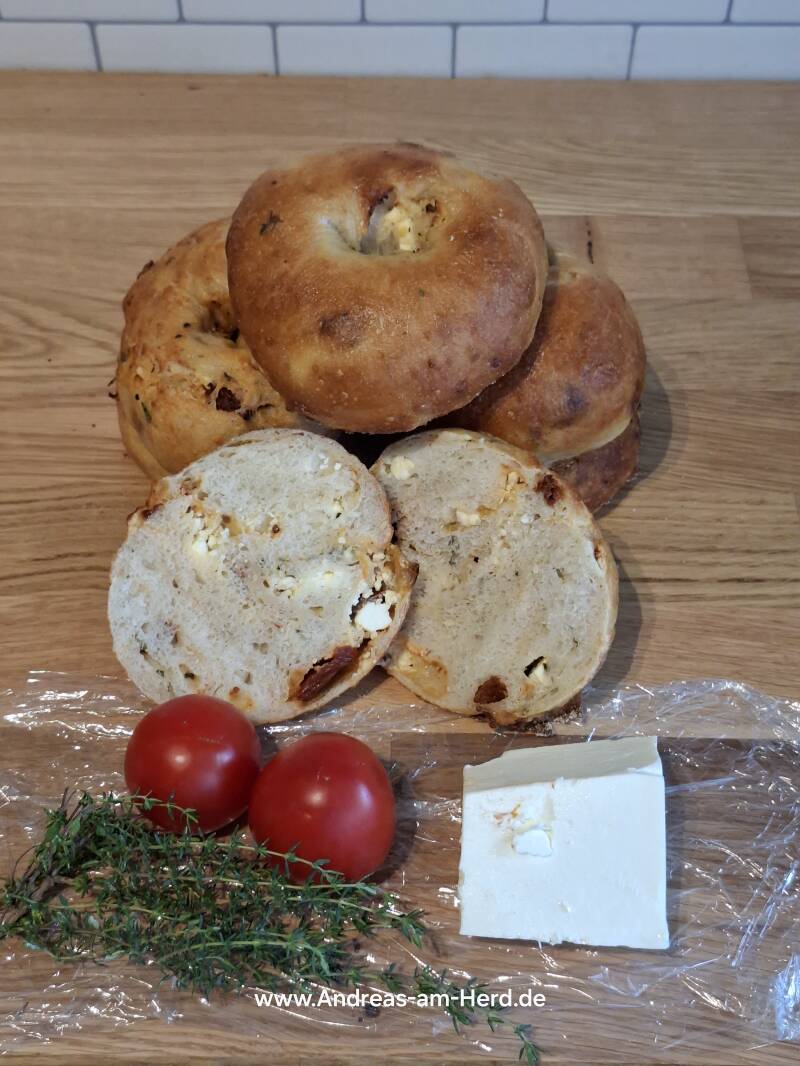
Recipe for 9 bagels (130 g each)
Sourdough starter: 60 g Levito Madre – 30 g warm water – 60 g Manitoba flour
Pre-dough: 100 g Manitoba flour – 1 g dry yeast – 100 g cold water
Cooked paste (*Tangzhong*): 30 g Manitoba flour – 100 g boiling milk
Main dough:
- 310 g Manitoba flour
- 150 g Type 550 wheat flour
- 10 g baking enzymes (optional)
- 5 g dry yeast
- 100 g cold water
- 25 g apple cider vinegar
- 12 g salt
- 10 g sugar
- 2 tbsp sunflower oil
- 6 sun-dried tomatoes (in oil)
- 125 g feta cheese
- Fresh thyme
Knead everything into a smooth dough. Duration: approx. 15 minutes.
Once the dough pulls away completely from the sides of the bowl, knead in the butter. Turn the dough out onto a lightly floured work surface and shape it into a rectangle.
Pat the tomatoes dry, dice the feta, and pluck the thyme leaves; distribute these over the dough. Fold/roll the dough over itself several times from all directions.
Place the finished dough into a lightly oiled container and let it rise for 90 to 120 minutes. Perform a "stretch and fold" every 30 minutes during this time.
Once the dough has at least doubled in size, divide it into 9 equal pieces (130 g each) and shape them into rounds. Let rest for 10 minutes. Then shape as usual.
Let rise again for approx. 45 minutes. Bring approximately 1 1/2 liters of water to a boil in a pot with 2 tablespoons of honey and 1 teaspoon of baking soda.
Boil the bagels for 30 seconds on each side.
Place them on a baking sheet lined with parchment paper. Brush with an egg-and-milk mixture and bake at 180°C (top and bottom heat) with plenty of steam for about 17 minutes.
My Hokkaido Pumpkin Rolls
Just look at that color—vibrant orange! The slightly nutty, mildly sweet aroma of the Hokkaido pumpkin gives the baked goods a mild flavor. They taste great with either sweet spreads or savory toppings. The starch and moisture in the pumpkin puree create a particularly moist, fine crumb and keep the rolls fresh for significantly longer. The crust remains delicately crisp.
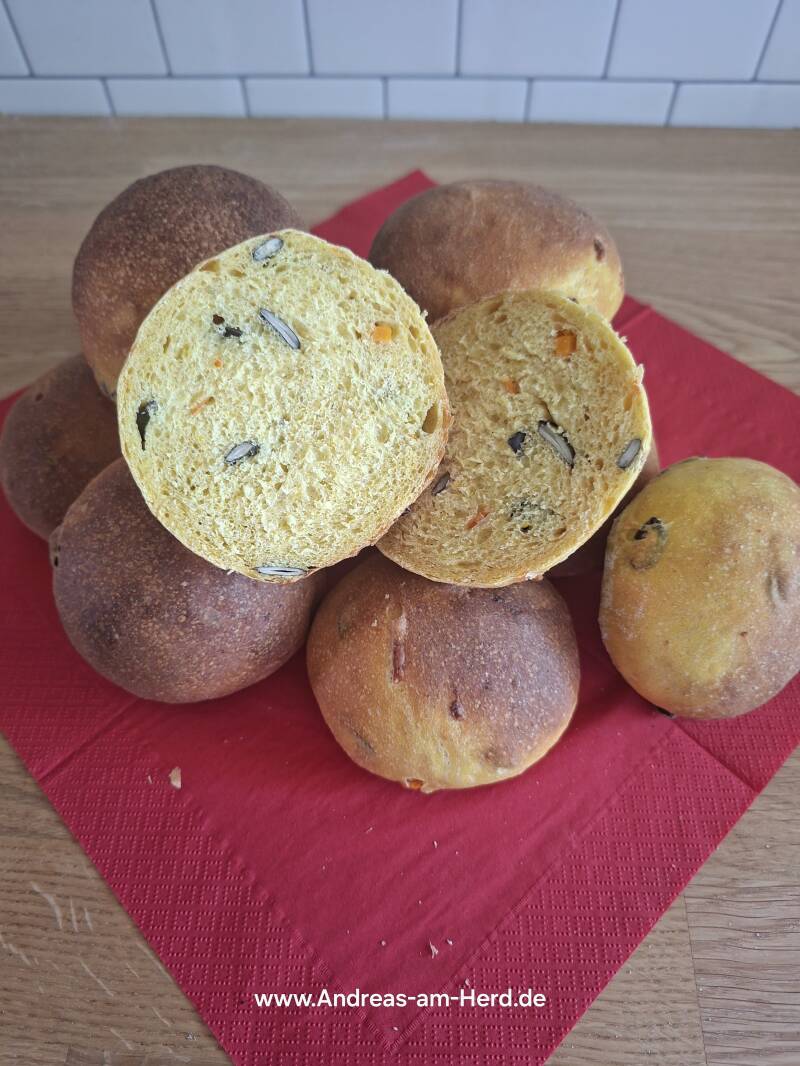
Recipe for 12 rolls (100 g each)
Pre-ferments: 100 g Manitoba flour, 100 g cold water, 1 g dry yeast
Sourdough starter: 60 g Levito Madre, 30 g warm water, 60 g Manitoba flour
Cooked flour paste (tangzhong): 40 g Manitoba flour, 100 g boiling water Let the 3 pre-ferments sit, covered, for 10–12 hours or overnight.
Main dough:
- the 3 pre-ferments
- 300 g Manitoba flour
- 100 g "Bauernmehl" (rustic flour blend) ***
- 10 g baking enzymes (optional)
- 2 g dry yeast
- 100 g cold whole milk
- 150 g cooked Hokkaido pumpkin
- 50 g Hokkaido pumpkin, cut into fine strips
- 10 g sugar (optional)
- 12 g salt
- 25 g butter or lard
- 50 g pumpkin seeds
*** "Bauernmehl" (rustic flour blend), a mixture of: 75% wheat flour (Type 1050) and 25% rye flour (Type 997)
Egg wash: 1 egg, a little milk For sprinkling:
Pumpkin seeds
- Dice the Hokkaido pumpkin, sauté until soft in 25 g of butter, and let cool. - Cut 50 g of Hokkaido pumpkin into small, fine strips.
- Mix the dry ingredients. Add the pre-ferments, milk, pumpkin, and pumpkin seeds.
- Knead everything into a smooth, soft dough. Add the salt after approx. 5 minutes. Once the dough pulls away completely from the sides of the bowl, transfer it to a lightly oiled dough container.
- Let the dough rest for 60 minutes, performing a stretch-and-fold every 30 minutes.
- Place the dough in the refrigerator for 12–15 hours or overnight.
- On baking day, remove the dough from the refrigerator and let it come to room temperature.
- Degas the dough on a lightly floured work surface and divide it into 10 equal pieces. Shape into rounds and let proof, covered, for approx. 60 minutes.
- Preheat the oven to 250°C
- Brush the dough balls with egg wash and sprinkle with pumpkin seeds, pressing them down gently.
- Place the rolls in the oven and steam well. After 10 minutes, release the steam and lower the temperature to 220°C
. Baking time: approx. 20 minutes.
super soft Potato-Cheese Rolls
Yes, I’m currently developing a lot of bread roll recipes that use cooked potatoes. It’s no wonder, really—they make the crumb beautifully soft and help the rolls stay fresh for a long time. This time, I incorporated 150 g of mashed boiled potatoes (cooked in their skins) and 100 g of grated cheese into the dough. Be a bit careful when adding water, though; the potatoes contribute a lot of moisture, so the dough can quickly become too soft and difficult to handle. I also included 100 g of "Bauernmehl" (farmer's flour). This isn't a specific type of flour on its own, but rather a blend of wheat and rye flour. My ratio is: 70% Type 1050 wheat flour 30% Type 997 rye flour
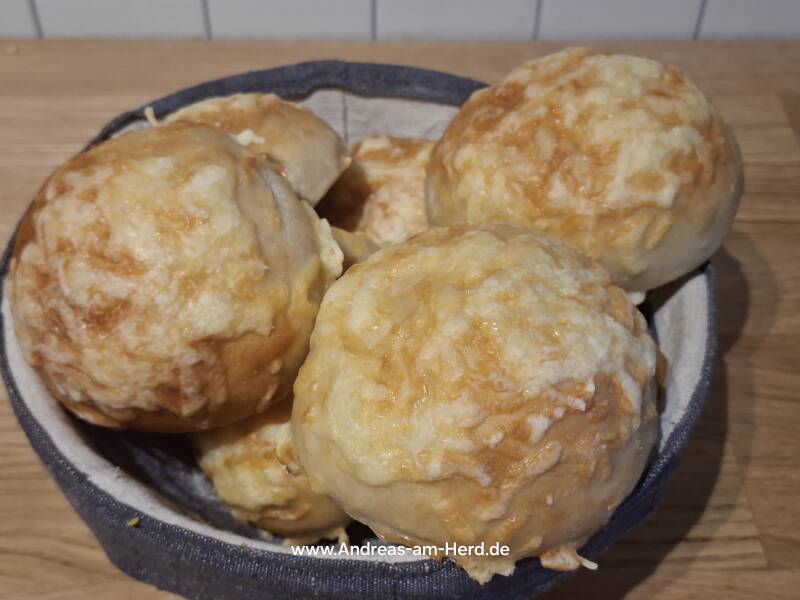
Recipe for 11 rolls (95 g each)
- 400 g Manitoba flour
- 100 g rustic flour (or farmhouse-style flour) **
- 10 g baking enzymes (optional)
- 2 g dry yeast
- 50 g Levito Madre (sourdough starter)
- 10 g sugar
- 100 g grated cheese (Gouda)
- 150 g cooked, mashed potatoes
- 200 g cold water
- 12 g salt
- 25 g apple cider vinegar
- 25 g soft butter or lard Egg wash
: Eggwash: 1 small Egg and a little milk
For sprinkling: 150 g cheese (Gouda)
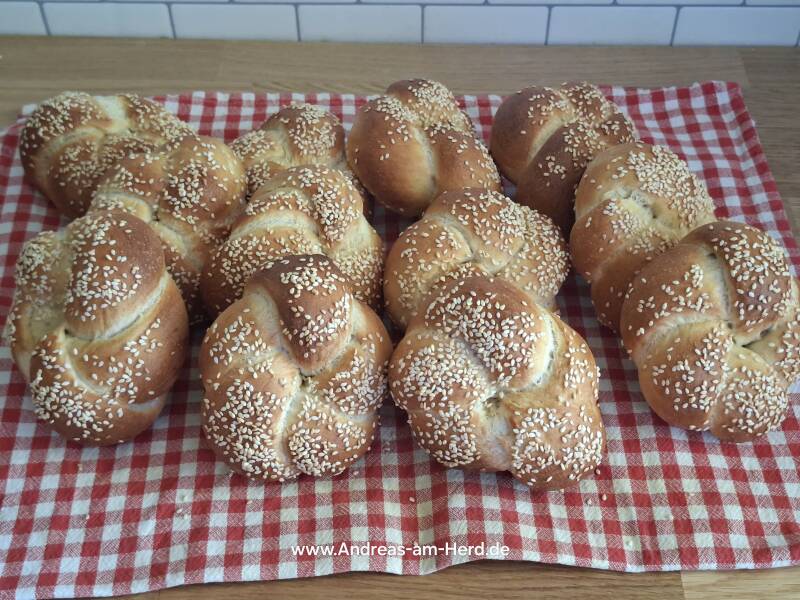
Potato and Sesame Seed Rolls
Exceptionally moist and soft: potatoes retain moisture, keeping the rolls fresh for longer. Potatoes and flour provide carbohydrates, making the rolls satisfyingly filling. The potatoes ensure the dough is wonderfully soft without requiring much oil or butter. Potato and toasted sesame seeds make a great combination. Versatile: ideal for breakfast or as an accompaniment to soups and salads.
*** Bauernmehl ist ein kräftiges, aromatisches Mehl, das traditionell für rustikale Brote und Brötchen verwendet wird. Es enthält meist einen höheren Anteil an Randschichten des Getreidekorns und hat dadurch mehr Geschmack und Mineralstoffe als helles Weizenmehl.
Ich persönlich mische es aus 75% Weizenmehl 1050 er und 25 % Roggenmehl 997er
Ingredients for 12 rolls (95 g each)
Pre-ferment: - 100 g Manitoba flour, 1 g dry yeast, 100 g cold water
Sourdough starter: - 60 g Levito Madre, - 30 g lukewarm water, - 60 g Manitoba flour
Prepare both pre-ferments the evening before and leave them covered in the kitchen overnight.
Autolyse dough:
- 350 g Manitoba flour
- 150 g rustic flour (e.g., a blend of wheat and rye) ***
- 10 g baking enzymes (optional)
- 2 g dry yeast
- 10 g sugar
- 100 g cold whole milk
Mix the ingredients lightly and let rest for 30 minutes.
Main dough:
- Add the sourdough starter and pre-ferment
and 150 g boiled potatoes. Knead everything into a smooth, soft dough.
- Add 12 g salt after 5 minutes
- once the dough pulls away completely from the sides of the bowl
- knead in 30 g soft lard.
- Place the dough in a lightly oiled container and let rise for 90 minutes, performing a stretch-and-fold every 30 minutes.
- Degas the dough on a lightly floured work surface and divide into 12 equal pieces of 95 g each. First, shape into rounds, then form into ropes approx. 35 cm long. Tie the ropes into knots and place on a baking sheet lined with parchment paper. Let rise, covered, for 60 minutes.
- Preheat the oven to 250°C (convection/fan setting). - Brush the rolls with egg wash and sprinkle with sesame seeds.
- Place the rolls in the oven, steam well, and lower the temperature to approx. 210°C.
- Baking time: 16 minutes.
My Potato & Cream Cheese Rolls I
I found a recipe online for rolls with cream cheese in the dough. Since I don't like spelt flour, I decided to modify the recipe on the fly. The result is something completely new.
1. I increased the amount of flour, replacing Type 630 spelt flour with Manitoba flour and Type 1050 wheat flour, and swapping whole-grain rye flour for Type 815 rye flour.
2. I added 100 g of *Levito Madre* (Italian sourdough starter) straight from the fridge, along with just a little dry yeast.
3. I also added 150 g of boiled, mashed potatoes to the dough.
4. I replaced the olive oil with lard.
5. I used a long, cold overnight fermentation in the fridge.
Over the last few years, I’ve tried many recipes that include potatoes in the dough. They have always worked well and tasted delicious. Potatoes make rolls incredibly moist and fluffy, and help them stay fresh for a long time. The cream cheese adds a pleasant, mild tang and extra softness. Plus, it’s a great way to use up leftovers!
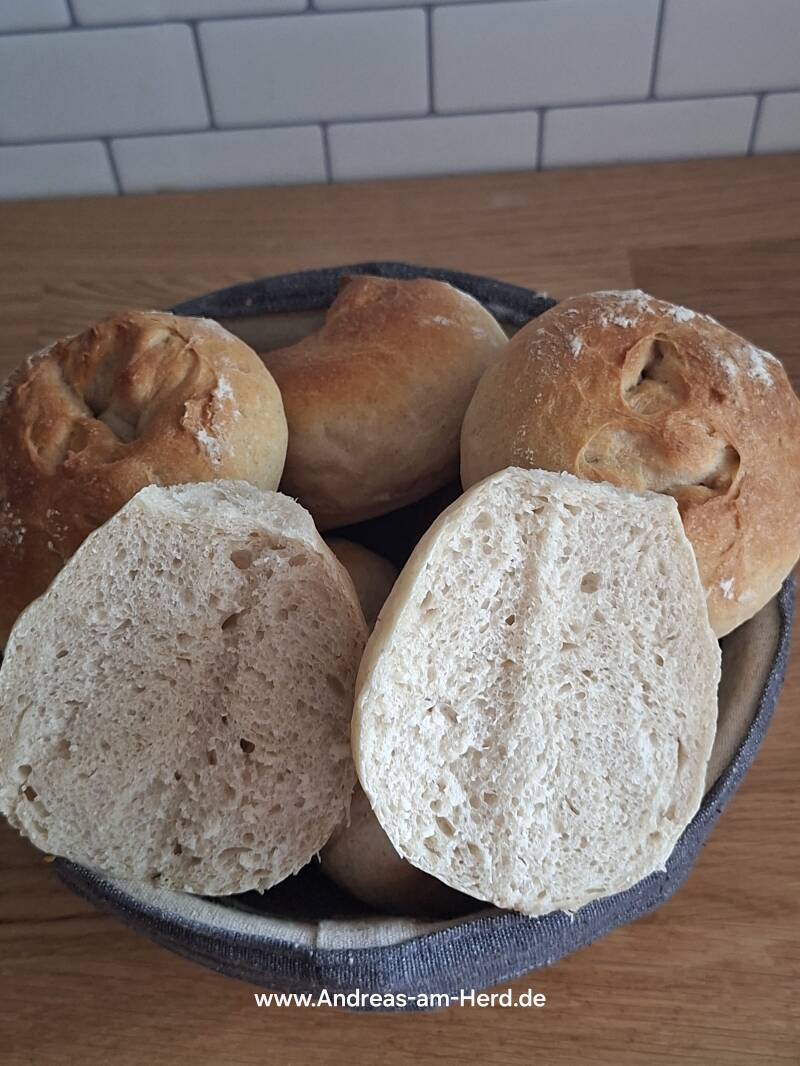
Yields 14 rolls (95 g each).
Afternoon, approx. 4:00 PM.
Autolyse dough:
- 500 g Manitoba flour
- 150 g Type 1050 wheat flour
- 50 g Type 815 or 997 rye flour
- 10 g baking enzymes (optional)
- 5 g dry yeast
- 250 g cold water.
Note: Potatoes and cream cheese contribute significant moisture.
Main dough:
The autolyse dough
- 20 g sugar
- 100 g Levito Madre (from the fridge)
- 150 g boiled potatoes
- 100 g cream cheese
- 15 g salt
- 25 g lard. Add a little extra water later if needed (bassinage). Combine the autolyse dough and the remaining ingredients (except salt and butter) and knead into a smooth, supple dough.
- Kneading time: approx. 20 minutes.
- Add the salt after 10 minutes.
- Knead until the dough pulls away completely from the sides of the bowl. Then knead in the butter, adding it in small flakes.
- Place the dough in a lightly oiled container and let it rise for 60 minutes. Perform a stretch-and-fold every 30 minutes.
- Place in the refrigerator for a cold ferment of approx. 12 hours.
On baking day:
- Remove dough from the refrigerator and let it acclimatize for 2 hours.
- Degas the dough on a lightly floured work surface and divide into 14 pieces (95 g each).
- Gently shape into rounds; the seam should not close completely. Place seam-side down on a floured baker's linen. Rest for 60 minutes.
- Preheat oven to 250°C (top and bottom heat).
- Carefully turn the dough pieces over and place them on a baking sheet.
- Place the rolls in the oven and bake with plenty of steam.
- After 10 minutes, release the steam, lower the temperature to 210°C, and finish baking. Baking time: approx. 20 minutes.
Blueberry Bagel
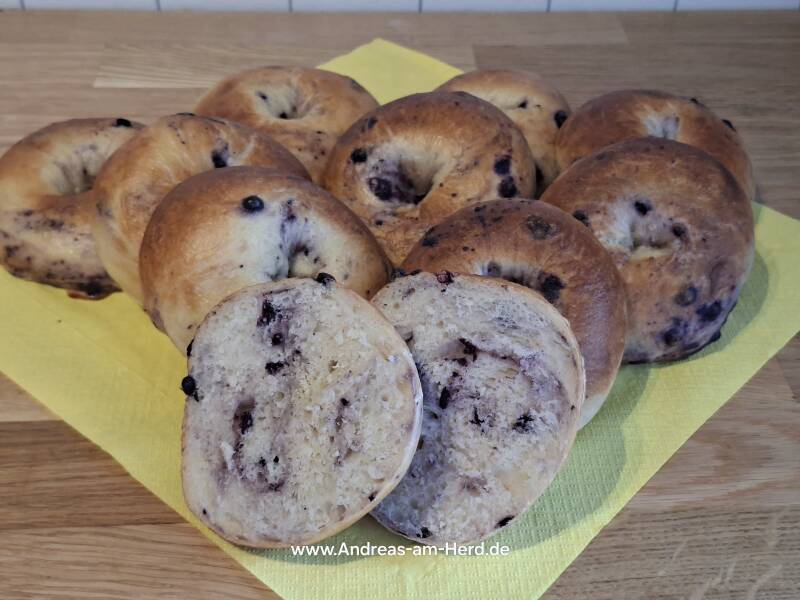
Ingredients for 10 bagels (115 g each)
Sourdough starter: 60 g Levito Madre – 30 g warm water – 60 g Manitoba flour
Pre-ferment: 100 g Manitoba flour – 1 g dry yeast – 100 g cold water Cooked flour paste (*Tangzhong*): 30 g Manitoba flour – 100 g boiling milk
Main dough:
- 310 g Manitoba flour
- 150 g Type 550 wheat flour
- 10 g baking enzymes (optional)
- 5 g dry yeast
-100 g cold whole milk
- 25 g apple cider vinegar
- 12 g salt
- 20 g sugar
- 8 g vanilla sugar
- 2 tbsp sunflower oil
- 50 g frozen blueberries
Knead everything into a smooth dough. Duration: approx. 15 minutes. When the dough pulls away completely from the sides of the bowl, knead in the butter. Turn the dough out onto a lightly floured work surface and shape it into a rectangle. Distribute the frozen blueberries over it and roll up the dough several times from all directions. Place the finished dough into a lightly oiled container and let it rise for 90 to 120 minutes. Perform a stretch-and-fold every 30 minutes during this time. Once the dough has at least doubled in size, divide it into 9 equal pieces (120 g each) and shape them into smooth rounds. Let rest for 10 minutes. Then shape as usual. Let rise again for approx. 45 minutes. Bring approximately 1.5 liters of water to a boil in a pot with 2 tablespoons of honey and 1 teaspoon of baking soda. Boil the bagels for 30 seconds on each side. Place them on a baking sheet lined with parchment paper. Brush with an egg-and-milk mixture and bake at 180°C (top and bottom heat) with plenty of steam for about 17 minutes.
jalapeño-Tomato-Cheese Bagel
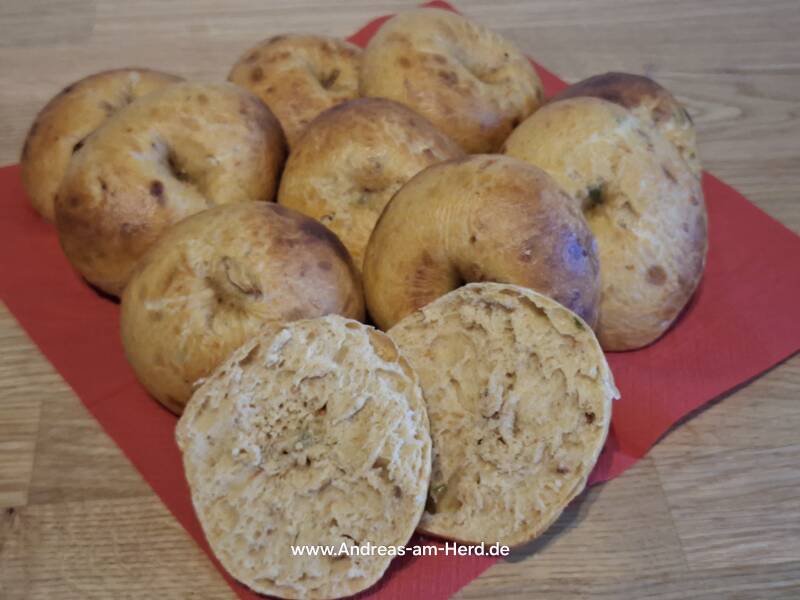
Ingredients for 10 bagels (120 g each)
Sourdough starter: 60 g Levito Madre – 30 g warm water – 60 g Manitobaflour
Pre-ferment: 100 g Manitoba flour – 1 g dry yeast – 100 g cold water
Cooked flour paste (tangzhong): 30 g Manitoba flour – 100 g boiling water
Main dough:
- 310 g Manitoba flour
- 150 g Type 550 wheat flour
- 10 g baking enzymes (optional)
- 5 g dry yeast
- 100 g cold water
- 25 g apple cider vinegar
- 12 g salt - 10 g sugar
- 2 tbsp sunflower oil
- 30 g jalapeños
– 30 g sun-dried tomatoes
– 75 g grated cheese Knead everything into a smooth dough. Duration: approx. 15 minutes. When the dough pulls away completely from the sides of the bowl, knead in the butter; towards the end, add the jalapeños, sun-dried tomatoes, and cheese. Place the finished dough in a lightly oiled container and let it rise for 90 to 120 minutes. Perform a stretch-and-fold every 30 minutes. Once the dough has at least doubled in size, divide it into 9 equal pieces (120 g each) and shape them into rounds. Let rest for 10 minutes. Then shape as usual. Let rise again for approx. 45 minutes. Bring approx. 1.5 liters of water to a boil in a pot with 2 tablespoons of honey and 1 teaspoon of baking soda. Boil the bagels for 30 seconds on each side. Place on a baking sheet lined with parchment paper. Brush with an egg-and-milk mixture and bake at 180°C (top and bottom heat) with plenty of steam for approximately 17 minutes.
My Sauerkraut and Potato Rolls with a Mustard Crust
Go ahead and call me crazy—my wife certainly did when I started developing these rolls. You’ve almost certainly never had a roll like this in your bread basket before. A roll with sauerkraut and potatoes right in the dough? Well, it doesn’t get much more German than that, does it? And it gets even better: the shaped dough is brushed with medium-hot mustard and sprinkled with a seed mix. By the way, you won’t actually taste the individual notes of beer, sauerkraut, potatoes, or mustard, but the combination of all of them gives the rolls a brilliant flavor. They are crispy on the outside with a wonderfully soft, airy crumb.
A quick tip: Don't add any water to the main dough at first, even if it seems very dry initially. The sauerkraut and potatoes contain a lot of moisture, so the dough will become very soft after a few minutes. It does need to be kneaded for a long time—about 20 minutes.
Recipe for 12 rolls (100 g each)
Pre-ferment: - 100 g Manitoba flour - 1 g dry yeast - 100 g cold water
Sourdough starter: - 60 g Levito Madre - 40 g warm water - 60 g Manitoba flour
Scalded flour mixture (Tangzhong): - 30 g Manitoba flour - 100 g boiling milk Prepare the pre-ferments and the scalded flour mixture in the afternoon; cover and let sit in the kitchen for 12–18 hours.
Main dough:
- 310 g Manitoba flour
- 100 g rye flour (Type 815)
- 4 g dry yeast
- 12 g baking enzymes (optional)
- 6 g lecithin granules (optional)
- 100 g boiled potatoes (mashed)
- 100 g sauerkraut
- 10 g honey
- 60 g cold water
- 15 g salt
- 30 g lard - medium-hot mustard - seed mix (sesame, flaxseed, sunflower seeds)
- Mix the dry ingredients - dissolve the lecithin granules in malt beer - knead everything except the salt and lard into a smooth dough (approx. 15 min.)
- Add the salt after 5 minutes
- Once the dough pulls away completely from the sides of the bowl, knead in the lard.
- Place the dough in a lightly oiled container and let it begin to rise for approx. 60 minutes; perform a stretch-and-fold twice.
- Place the dough in the refrigerator until the next morning
- On baking day, let the dough acclimatize briefly.
- Degas on a lightly floured work surface and divide into 12 equal pieces. Shape into rounds, ensuring the seam does not close completely.
- Place on a baking sheet lined with parchment paper, brush with mustard, and press into the seed mixture.
- Let rise, covered, for 60 minutes.
- Meanwhile, preheat the oven to 250°C (top and bottom heat).
- Place the rolls in the oven and bake with plenty of steam.
- After 10 minutes, release the steam and lower the temperature to 220°C. Baking time: 20 to 25 minutes.
My "Power Sticks" – Healthy Seed-Coated Sticks
They are characterized by a crispy exterior created by rolling them in seeds, while the inside remains soft and fluffy. These sticks are generously coated in oilseeds such as flaxseed, sesame, poppy, sunflower, or pumpkin seeds. They can be topped with savory ingredients (like cheese or cold cuts) or sweet ones (like jam). However, thanks to their nutty flavor, they also taste excellent on their own.
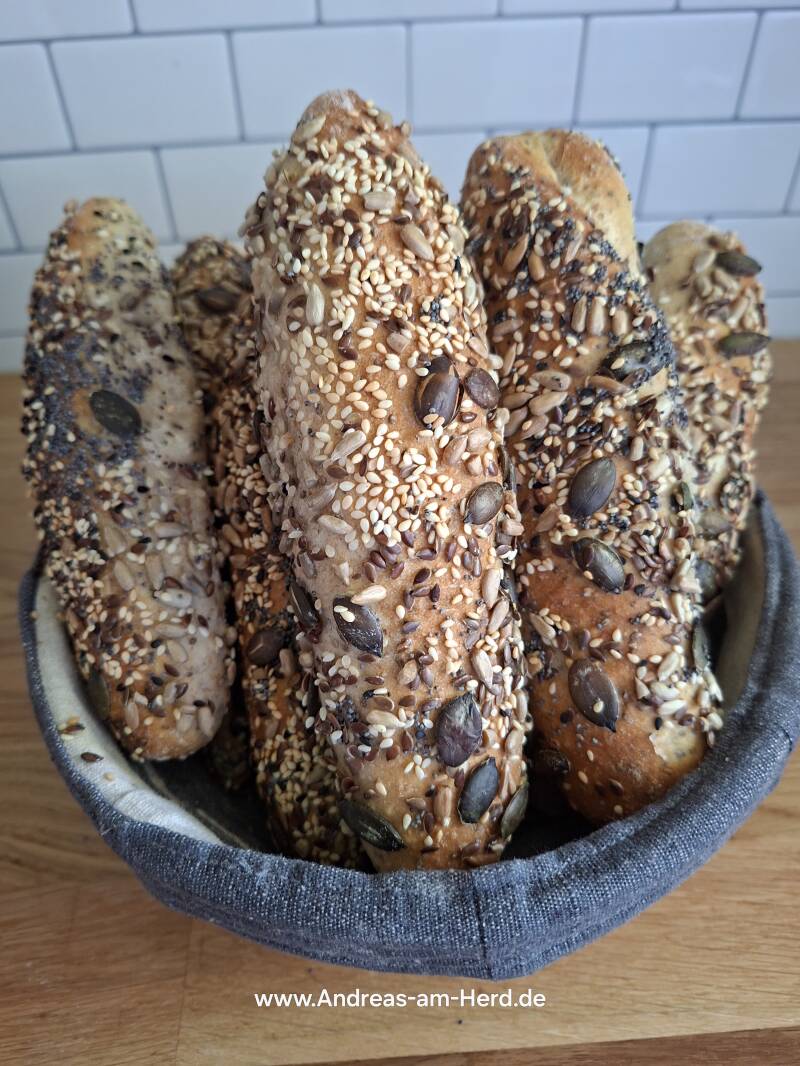
Ingredients for 12 seeded rolls (approx. 100 g each)
Sourdough starter: 50 g Levito Madre – 100 g warm water – 100 g Manitoba flour
Cooked flour paste: 50 g Manitoba flour – 100 g boiling water
Soaked seed mixture: 30 g chia seeds – 100 g boiling water
The next morning: Main dough:
- Sourdough starter, cooked flour paste, and soaked seed mixture
- 300 g Manitoba flour
- 100 g whole wheat flour
- 100 g rolled oats
- 10 g baking enzymes (optional)
- 5 g dry yeast
- 100 g quark (40% fat)
- 100 g cold water
- 13 g salt
Mix the dry ingredients, add all other ingredients, and knead into a smooth dough. Duration: approx. 15 minutes.
Place the dough in a lightly oiled container and let it rise for 90–120 minutes. Perform a "stretch and fold" every 30 minutes.
Degas the dough on a lightly floured work surface and divide into 9 equal pieces.
Shape into rounds and let rest for approx. 10 minutes.
Roll out each piece of dough to a thickness of approximately 3 mm. Stretch the bottom edge slightly and roll up tightly. Lightly moisten the shaped rolls and roll them in a seed mixture (poppy seeds, sesame seeds, flaxseeds, pumpkin seeds, and sunflower seeds).
Let the rolls rise, covered, for 60 minutes.
Preheat the oven to 250°C (top and bottom heat). Place the rolls in the oven and steam.
After 10 minutes, release the steam and lower the temperature to 220°C. Baking time: approx. 17–20 minutes.
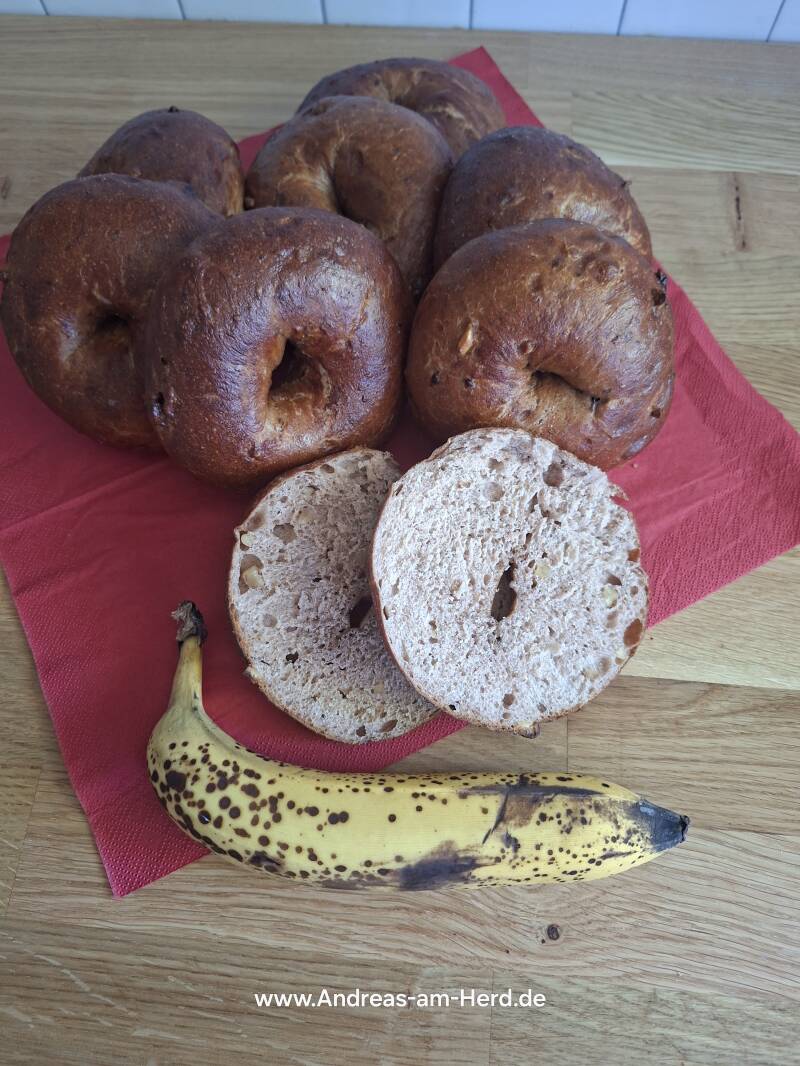
My Hawaiian Bananabread Bagel
The ideal way to use up overripe bananas
It combines the comforting, sweet-spiced flavor of moist banana bread with the firm, wonderful texture of an authentic New York bagel.
The flavor:
As soon as you toast it, the whole kitchen fills with the aroma of ripe bananas, brown sugar, cinnamon, and a subtle hint of caramel. The dough is mildly sweet, yet not nearly as heavy or rich as cake.
The texture:
On the outside, it has the signature glossy, slightly chewy crust typical of traditional bagels. Inside, the crumb is wonderfully dense, springy, and moist, holding its shape perfectly.
You can easily slice the banana bread bagel, toast it until golden brown, and spread it with whatever your heart desires.
Ingredients:
- 500 g Manitoba flour
- 50 g whole wheat flour
- 35 g brown sugar
- 1 tsp cinnamon
- 1/2 tsp grated nutmeg
- 10 g baking enzymes (optional)
- 5 g dry yeast
- 11 g salt
Lightly mix all dry ingredients.
- 200 g overripe mashed bananas
- 70 g chopped walnuts (toasted)
- 30 g Levito Madre (optional)
- 200 g cold whole milk
- 25 g soft butter
Add the banana, Levito Madre (straight from the fridge), and milk.
Knead everything into a smooth dough. Duration: approx. 15 minutes.
Once the dough pulls away completely from the sides of the bowl, knead in the butter.
Place the finished dough into a lightly oiled container and let it rise for 90 to 120 minutes. Perform a stretch-and-fold every 30 minutes during this time.
Once the dough has at least doubled in size, divide it into 9 equal pieces (120 g each) and shape them into smooth balls. Let rest for 10 minutes. Then shape as desired.
Let rise again for approx. 45 minutes.
In a pot, bring approx. 1.5 liters of water to a boil with 2 tablespoons of honey and 1 teaspoon of baking soda.
Boil the bagels for 30 seconds on each side.
Place on a baking sheet lined with parchment paper. Brush with an egg-milk wash and bake at 180°C (top/bottom heat) with plenty of steam for approx. 17 minutes.
Potato "World Champion" Rolls
Even though Germany is a very, very long way from a title, these rolls are a must! A brilliant combination: the moistness of a potato roll paired with the hearty, seeded crust of the "World Champion" style (poppy, sesame, and flax seeds on top; sunflower seeds on the bottom; plus poppy, sesame, and flax seeds in the dough).
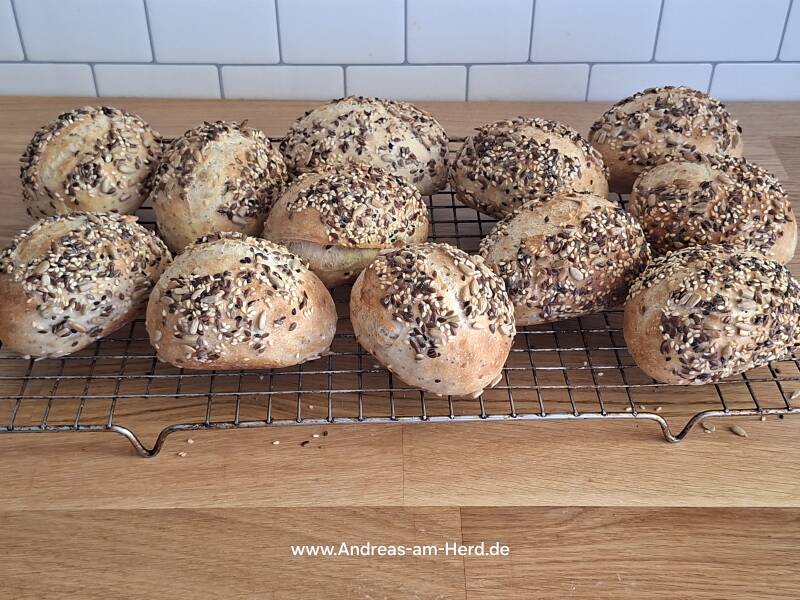
Recipe for 12 rolls (90 g each)
- 400 g Manitoba flour - 100 g Type 1050 wheat flour - 50 g Levito Madre - 10 g Baking enzymes (optional) - 2 g Dry yeast - 200 g Mashed boiled potatoes - 250 g Cold water - 12.5 g Salt - 25 g Lard - 40 g Seeds (mixed seeds) - 10 g Honey
Knead the ingredients into a soft dough,
- Add 14 g salt after 5 minutes
- Once the dough pulls away completely from the sides of the bowl, knead in 25 g lard or butter, adding it in small flakes.
- Place in a lightly oiled dough container. Let rest for 60 minutes performing a stretch-and-fold twice—then place in the refrigerator overnight for 12 hours.
- The next morning, remove the dough from the refrigerator and let it come to room temperature.
- Turn the dough out onto a lightly floured work surface and degas. - Divide the dough into equal-sized pieces and shape into rounds. Ensure the seam does not seal completely so the rolls spring open nicely during baking. Moisten the tops and press into the seeds.
- Place on a baking sheet lined with parchment paper and let proof, covered, for 45 minutes. Score the rolls after proofing.
- Place in an oven preheated to 250°C (top/bottom heat) and steam well.
- After 10 minutes, release the steam and lower the temperature to 230°C. Baking time: approx. 20 minutes.
My Cheese Pretzel Sticks
Cheese pretzel sticks are a popular, savory pastry made from a fluffy yeast dough that is dipped in a lye solution before baking and then topped with grated cheese. The result is a combination of a soft crumb and a savory, crispy cheese crust.

Recipe for 11 cheese sticks (115 g each)
- 500 g Manitoba flour - 250 g Type 550 wheat flour - 7.5 g baking enzymes (optional) - 5 g lecithin granules (optional) - 3 g dry yeast - 150 g cold milk - 300 g cold water - 50 g lard - 15 g salt - 50 g baking soda (sodium bicarbonate) - 200 g grated Gouda cheese
Day 1, 4:00 PM:
- Dissolve the lecithin granules in the cold water.
- Mix the dry ingredients, except for the salt. Then add the water and milk and knead into a smooth, soft dough. Add the salt after 5 minutes. Once the dough pulls away completely from the sides of the bowl, knead in the lard. Once the dough has fully incorporated the lard, transfer it to a lightly oiled dough container.
- Let the dough rest for 60 minutes, performing a "stretch and fold" twice during this time. - Place the dough in the refrigerator for at least 12 hours for cold fermentation.
Day 2:
- In the morning, remove the dough from the refrigerator and let it come to room temperature.
- Degas the dough on a lightly floured work surface and divide it into equal-sized pieces. Shape the pieces into rounds and let them rest for 15 minutes. Shape the pieces into elongated forms. Let them proof again for 30 minutes.
- Bring 1.5 liters of water to a boil in a pot and stir in one packet of baking soda. Dip each piece of dough into the alkaline solution for about 1 minute.
- Place the dough pieces on a baking sheet lined with parchment paper. Score them lengthwise and sprinkle with cheese.
- Place the baking sheet in the oven, preheated to 250°C (top and bottom heat), and inject steam. Baking time: 18–20 minutes; after 10 minutes, release the steam and lower the temperature to 210°C.
German Pretzel Rolls
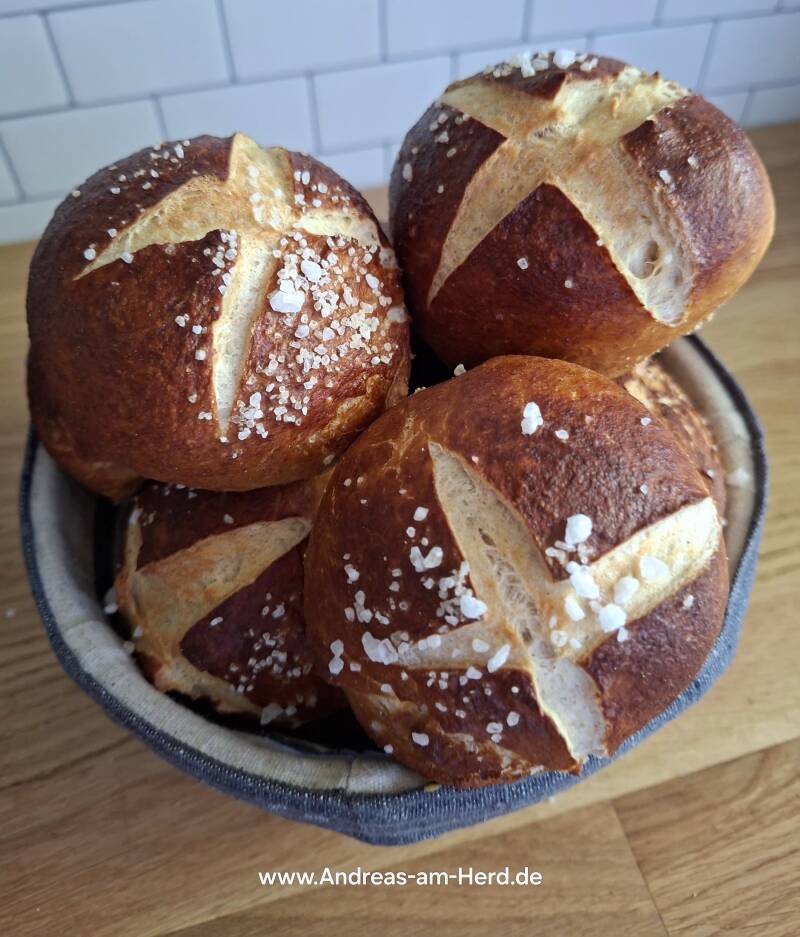
Recipe for 12 lye rolls (85 g each) T
the night before:
Sourdough starter: 40 g Levito Madre, 20 g warm water, 40 g wheat flour
Cooked flour paste (tangzhong): 40 g Type 550 wheat flour, 100 g boiling water
Main dough:
- Sourdough starter and cooked flour paste
- 520 g Type 550 wheat flour
- 10 g baking enzyme (optional)
- 6 g dry yeast
Mix the dry ingredients... Add the sourdough starter and cooked flour paste - -
120 g cold water
- 100 g cold whole milk
- Knead everything into a smooth dough. After 5 minutes, add 12 g salt. Knead until the dough pulls away completely from the sides and bottom of the mixing bowl.
- Add 30 g soft lard or butter. Continue kneading until the fat is fully incorporated into the dough. Place the dough in a container and let it rise, covered, for 90 minutes. Perform a stretch-and-fold twice during this time. Degas the dough on a lightly floured work surface, divide into 12 equal pieces, Shape into rounds, and place on a baking sheet lined with parchment paper. Let proof for 60 minutes.
Bring 1.5 liters of water to a boil, remove from heat, and stir in 50 g baking soda (sodium bicarbonate). Caution: it will foam vigorously! Simmer each roll in the hot water. Flip after 30 seconds.
Bake in a preheated oven at 250°C with plenty of steam. After 8 minutes, release the steam and lower the temperature to 220°C.
Baking time: 17 minutes.
My "Alster-Krüstchen"
The Alster is a river right in the middle of my hometown, Hamburg. Although I am finally very happy with my rolls after years of experimentation, I still always wonder how bakeries manage to produce such puffed-up rolls using so little dough. I’ve been baking my rolls with baking enzymes for a long time, which has yielded wonderful results. After doing some research online, I came across lecithin—something I naturally had to try right away. No sooner said than done! For 670 g of flour, I used my usual 1% baking enzymes and added 0.5% lecithin. The dough portions weighed 85 g each. Here you can see the result; as you can tell, they rose fantastically. The baking sheet was actually too small for the 14 rolls! They have a wonderfully crisp, crackly crust on the outside and are cotton-soft on the inside—but not the kind of "airy nothingness" you get from some supermarkets. I think I’ve discovered my new favorite roll.
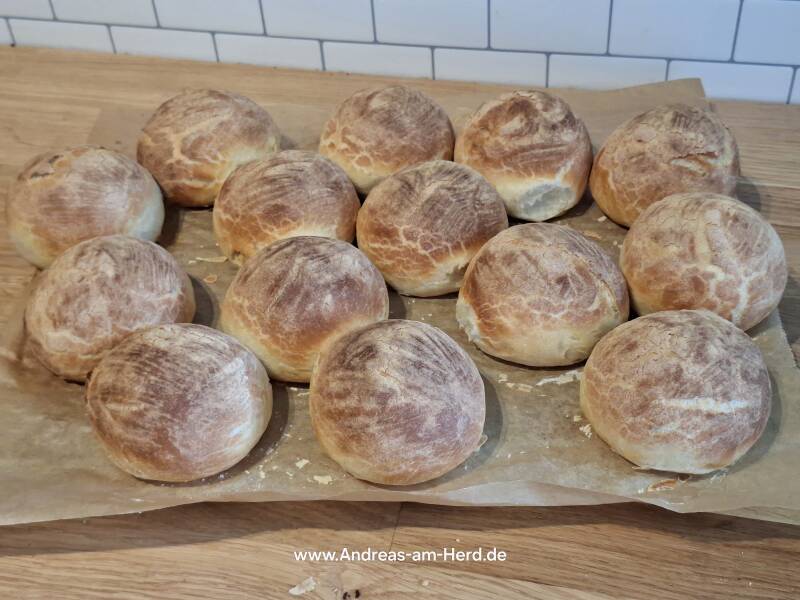
Recipe for 14 rolls (85 g each)
Pâte Fermentée (old dough) 100 g wheat flour (Manitoba or Type 550), 1 g dry yeast, 1 g salt, and 65 g cold water.
Prepare this dough approximately 48 hours before making the main dough. Sourdough starter (the evening before) 40 g Levito Madre, 20 g warm water, 40 g wheat flour Mix well and leave covered in the kitchen overnight. Cooked paste / Tangzhong (the evening before 40 g wheat flour and 100 g boiling whole milk Pour the boiling milk over the flour, mix well, and immediately cover with plastic wrap—placing it directly on the surface to prevent a skin from forming. Store in the refrigerator overnight.
Main dough 300 g Manitoba flour, 200 g wheat flour (Type 550), 7 g baking enzymes, 4 g lecithin, 5 g dry yeast, 14 g salt, 260 g cold water, 30 g lard or butter
Topping paste: 40 g rice flour, 10 g wheat flour, 1 g dry yeast, 75 g cold water
Dissolve the lecithin granules thoroughly in the cold water used for the dough. Mix the dry ingredients in the mixing bowl. Add the water and knead slowly for the first 5 minutes, then at a slightly higher speed. After about 15 minutes, the dough should have completely pulled away from the sides of the bowl. Only then add the lard or butter. Once the dough has fully incorporated the fat, transfer it to a dough container... ... Let the dough rest for 60 to 90 minutes (depending on the temperature), performing a stretch-and-fold twice during this time. Degas the dough on a lightly floured work surface. Divide into 14 equal pieces (85 g each), shape into rounds, and place on a baking sheet with sufficient spacing. Let the dough pieces proof, covered, for 30 minutes. Preheat the oven to 250°C (top and bottom heat). Place the rolls in the oven and steam well. After 5 minutes, reduce the temperature to 230°C. After 10 minutes, release the steam and finish baking. Baking time: 20 to 25 minutes.
Osnabrück "Springbrötchen" (Cracked-Crust Rolls)
Although they look like "tiger rolls," the way they are made is completely different! These rolls are a regional specialty from the Osnabrück area. Their hallmark is a rustic, cracked crust that creates a wild, almost tiger-like pattern. Inside, they are relatively soft and slightly sweet. I first learned about them through a report on a regional TV station. I found several recipes online, but what was missing was the use of sourdough. So, I set about reworking the recipe. I incorporated sourdough, a *Kochstück* (cooked flour paste), and an overnight bulk fermentation. I also used some Manitoba flour, as it has a higher protein content. The characteristic crust is created by applying several coatings during the dough-processing stage. A fat-based glaze containing baker's ammonia (ammonium bicarbonate) contributes to the distinctive flavor and the splitting of the surface. They are initially baked at a very high temperature (around 250°C), which makes the crust exceptionally crisp. The crumb is soft and fluffy.
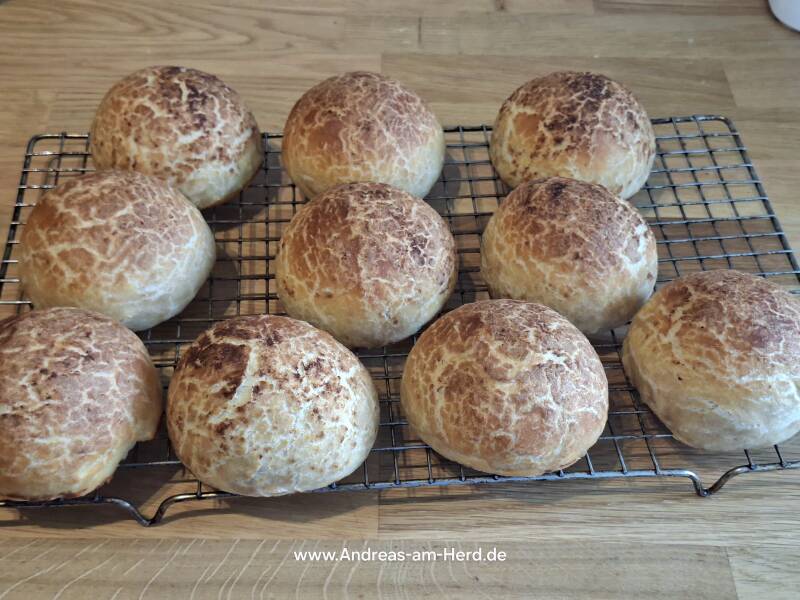
Ingredients for 10 rolls (90 g each)
Day 1, afternoon Sourdough starter:
- 40 g Levito Madre, 20 g warmes Wasser, 40 g Manitoba flour,
Predough
- 200 g Manitoba flour, - 2 g dry yeast, - 200 g cold whole milk
Cooked starch paste (tangzhong):
- 30 g bread flour, - 100 g boiling water
Day 2, morning
- 220 g Manitoba flour,
- 50 g rye flour (Type 810),
- 20 g potato flour
- 5 g dry yeast
- 10 g baking enzyme (optional)
- 15 g sugar
- 10 g Salt
Briefly mix the dry ingredients,
then:
- add the starter and the cooked starch paste, plus
- 80 g cold water, and work everything into a smooth dough. After 5 minutes, add the salt and knead the dough until it pulls away completely from the sides of the bowl. Duration: approx. 10–15 minutes. Then add the lard in small pieces. Once the dough has fully incorporated the lard, place it in a lightly oiled dough container.
- Dough rest: 60 minutes; perform a "stretch and fold" every 30 minutes. Then place the dough in the refrigerator for cold fermentation and overnight proofing (approx. 24 hours).
Day 3, morning - Remove the dough from the refrigerator and let it come to room temperature.
- Degas the dough on a lightly floured work surface, divide into 10 pieces (90 g each), and shape the pieces into rounds. Place the shaped dough pieces on a baking sheet and brush them with a flour wash for the first time.
1. Wash: 1 tbsp wheat flour, 100 ml hot water.
Let the shaped dough pieces dry and proof, covered, for 45 minutes.
2. Wash: 30 g rye flour, 80 g cold water.
Brush the dough pieces again and let them dry, covered, for another 25 minutes.
Preheat the oven to 250°C (top and bottom heat).
3. Wash: 50 g lard, 1/2 teaspoon baker's ammonia
Immediately after applying the third wash, place the rolls in the oven and steam well. After 5 minutes, open the oven door to release the steam and lower the temperature to 220°C. Baking time: 20 minutes. The rolls should have a nice split crust and be dark brown.
My Danish Butter Rolls
I came across the recipe for "Hornbeks Nemme Birkes" on the Danish website "Hornbek." It is a roll made from a dough similar to Danish pastry, yet much easier to prepare. As always, I tried it out and—naturally—had to tweak it immediately to suit my own preferences. First, I doubled the quantity of dough. At the same time, I reduced the amount of yeast. I incorporated a three-stage sourdough process and a pre-ferment. I also replaced some of the water with cold whole milk. However, since the "best wife of all" doesn't like poppy seeds, I swapped them for sesame seeds.
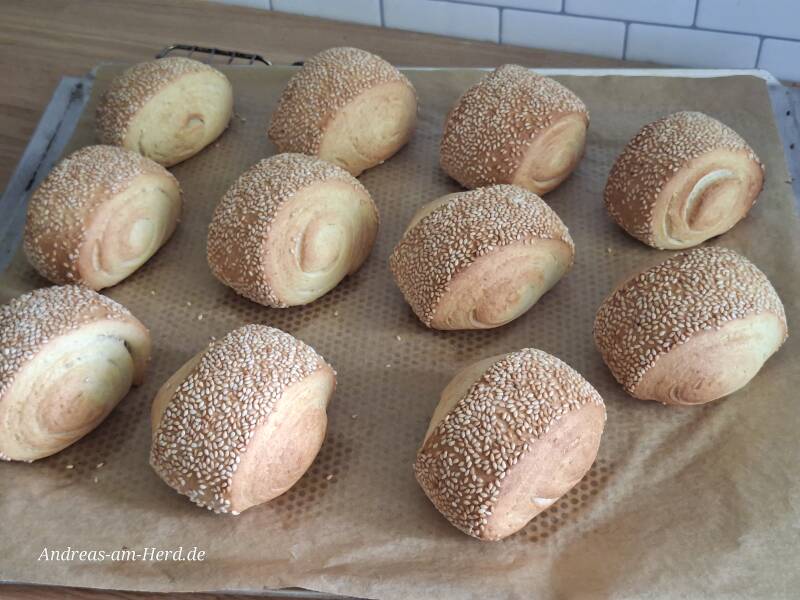
Preparation:
The night before:
3-stage sourdough starter:
- 30 g Levito Madre - 60 g warm water - 60 g Manitoba flour
Pre-dough:
100 g Manitoba flour - 1 g dry yeast - 100 g cold water
Let the sourdough starter and the pre-dough mature, covered, for 12–15 hours.
On baking day:
Autolyse dough 240 g Manitoba flour, 150 g durum wheat flour, 10 g baking enzymes (optional), 5 g dry yeast, 80 g cold whole milk
Knead the ingredients only briefly until no loose flour remains visible. Then let rest for 45 minutes.
Main dough:
Sourdough starter and pre-dough, 200 g butter, cubed 12 g salt
Add to the autolyse dough and knead everything thoroughly. The dough will appear very firm and dry. Sesame seeds for sprinkling. Preparation:
1. Place all dry ingredients in the mixing bowl and mix well. Add the remaining ingredients and knead on low speed until smooth and glossy. The dough is quite firm.
2. Place the dough in a lightly oiled container. Let rest for 60 minutes, performing a "stretch and fold" twice during this time.
3. Turn the dough out onto a lightly floured work surface.
4. Roll out into a rectangle and fold in thirds (letter fold). Repeat this process twice more.
5. If the dough becomes too warm or soft, chill it briefly in between steps.
6. Roll out into a rectangle and then roll up into a log. Press the log down slightly to flatten it. Let the dough rest, covered, for 15 minutes.
7. Mist the surface with water and sprinkle with sesame seeds.
8. Cut into pieces approximately 7 cm wide. Place the pieces on a baking sheet lined with parchment paper.
9. Let the shaped dough rise on the baking sheet, covered with plastic wrap, for 40–45 minutes.
10. Meanwhile, preheat the oven to 250°C (top and bottom heat).
11. Place the rolls in the oven, inject plenty of steam, and lower the temperature to 210°C.
12. Bake for approximately 15–17 minutes; release the steam after 10 minutes.
My Danish Beer Rolls with Whole Wheat
When we vacation in Denmark, we naturally have plenty of time and peace. This gives me the opportunity to try many new things. I found a similar recipe on a Danish website, "Hornbek." Of course, I significantly altered the recipe, starting with the quantities. For example, I drastically changed the rising times, incorporated a pre-ferment, and replaced the relatively short fermentation time with an overnight proof. I also used different flours (Manitoba flour and organic whole wheat flour), Levito Madre instead of sourdough starter, and replaced the water with Danish beer. This has the advantage that the yeast and carbonation in the beer greatly promote the rising of the dough and give the rolls a delicious, slightly salty flavor. The alcohol evaporates during baking. But the best part is that you can enjoy the leftover beer afterward. We don't want to waste anything! The rolls have a fantastic oven spring and have cracked open just as intended.
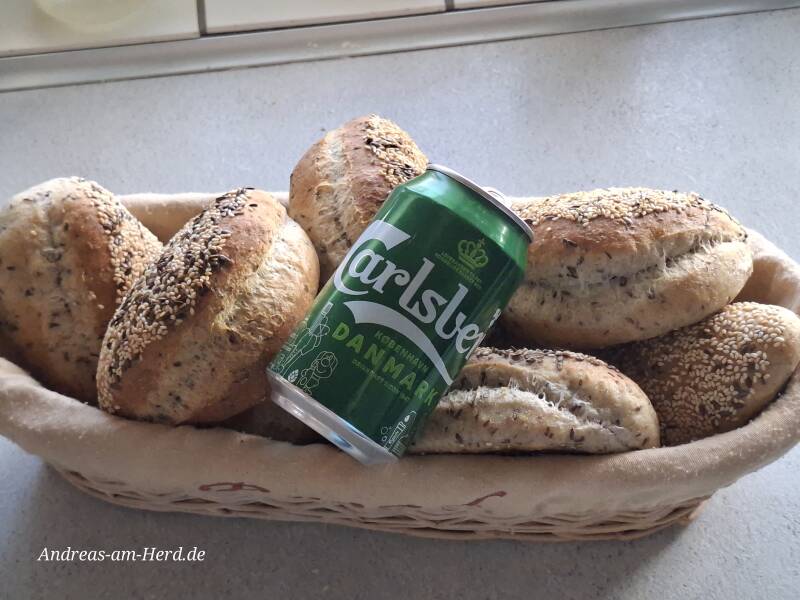
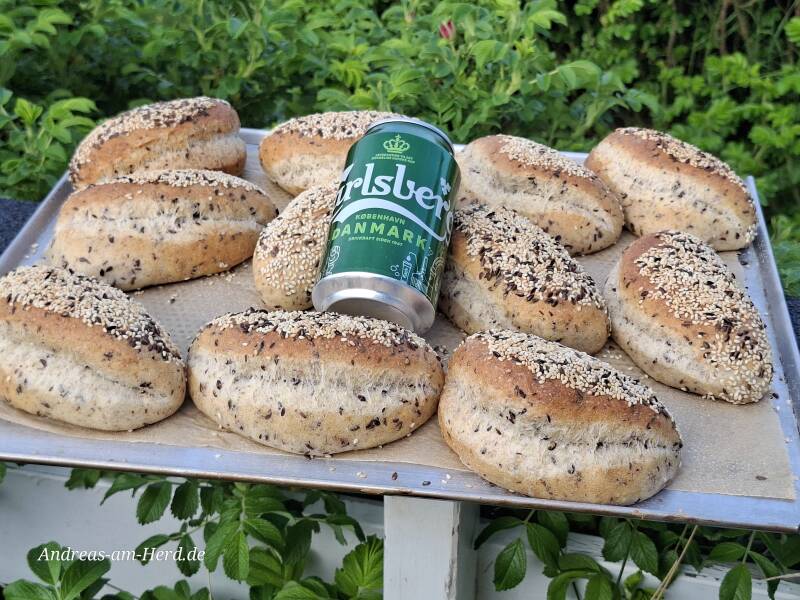
11 rolls, 95 g each
70% hydration
Preferment:
- 100 g whole wheat flour - 1 g active dry yeast - 100 g beer (I used Pilsner)
Main dough:
- 450 g Manitoba flour - 30 g sourdough starter - 3 g active dry yeast - 10 g baking enzymes - 40 g flax seeds - 315 g beer (Pilsner) - 10 g salt - 20 g sesame oil
For sprinkling: Sesame and flax seeds
8:00 AM: Prepare the preferment
6:00 PM: Main dough
- Combine the flours with the baking enzymes, active dry yeast, flax seeds, and the preferment. Add the beer, do not knead, mix to form an autolyse dough. Let it rest for 45 minutes.
- Knead the dough for about 10 minutes until smooth. Add the salt after 5 minutes. - Knead until the dough completely pulls away from the sides of the bowl. Then add the oil and finish kneading.
- Let the dough rest for 90 minutes, stretching and folding it twice during this time. Let it proof overnight in the refrigerator.
On baking day: Remove the dough from the refrigerator and let it come to room temperature.
- Place the dough on a lightly floured work surface. Degas the dough, divide it into 11 equal pieces, shape them into balls, and let them rest, covered, for 15 minutes. Roll each ball out into a circle and fold it over once to form a semicircle. Moisten the surface and press it into the seed mixture. - Cover and let rise in a warm place for about 45 to 60 minutes. - Preheat the oven to 250°C (480°F) using the convection setting. - Place a baking tray in the oven and steam it well. Reduce the temperature to 200°C (390°F). After 10 minutes, release the steam. Baking time: 18-20 minutes
My chia seed crusties
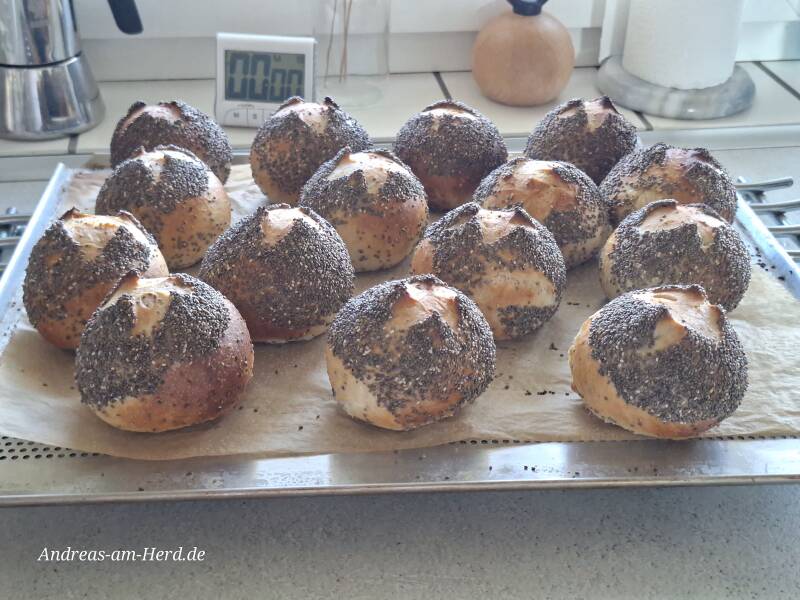
The evening before, around 7 p.m.
Sourdough:
50 g Levito Madre - 100 g warm water - 100 g Manitoba flour or wheat flour type 550
Cooking dough:
- 40 g Manitoba flour or wheat flour type 550 - 100 g boiling water
Soaker:
- 30 g chia seeds - 100 g boiling water On baking day, around 7 a.m.: Sourdough, cooking mixture, and soaker - 400 g Manitoba flour - 150 g wheat flour type 1050 - 15 g baking enzyme - 15 g fresh yeast 5 g dried yeast - 10 g sugar - 120 g cold water
- Dissolve the yeast and sugar in the water. I start with 100g of cold water. Then, gradually add the rest of the main dough as needed: - Mix the flour with the baking enzyme, then add the sourdough starter, the cooked starter, and the soaker, and pour in the water. Knead everything into a dough. - After 5 minutes, add the 12g of salt. Due to the moisture in the pre-ferment, it takes a while for the dough to completely detach from the sides of the bowl. For me, it took 18 minutes! Place the dough in a lightly oiled proofing container and let it rise for 90-120 minutes. Stretch and fold the dough every 30 minutes.- Degas the dough on a lightly floured work surface and divide it into 15 equal pieces. Shape the pieces into rounds, moisten the surface, and roll them in chia seeds. - Place the dough rounds on a baking sheet lined with parchment paper and cover. Proof for 45 to 60 minutes, depending on the temperature. - Meanwhile, preheat the oven to 250°C (480°F) using the convection setting. - Just before baking, cut a cross into the top of each roll with scissors. This will cause the rolls to rise beautifully in the oven and become extra crispy. - Spray the rolls with salt water. Place the baking sheet in the oven and allow plenty of steam. After 10 minutes, release the steam and reduce the temperature to 210°. Baking time: approx. 18 minutes.
Healthy Breakfast Rolls with Apple and Carrots
Such a delicious, soft, slightly sweet roll with a wonderful aroma that rises beautifully in the oven and stays fresh for a long time. I got the recipe from Marcel Paa, which I only slightly modified this time. It consists of a 100% biga dough and a soaker. This is very important in the dough preparation, as no additional water is added. The dough will initially appear a little dry, but the carrots and apple will add moisture.
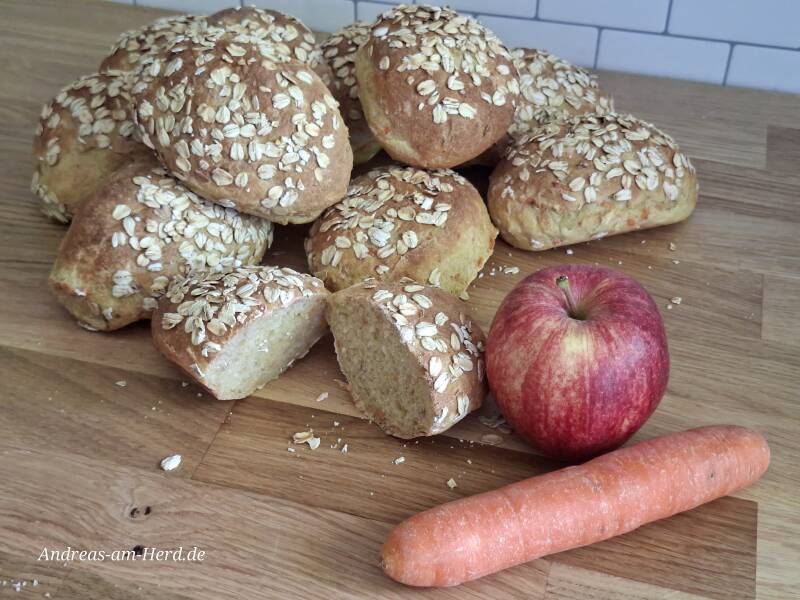
Biga:
- 220 g cold water - 1 g fresh yeast or 0.3 g active dry yeast - 250 g all-purpose flour (type 550)
Dissolve the yeast in the water, add the flour, and mix until no loose flour remains. Do not knead. Cover and let it activate for 1 hour, then refrigerate for 12 to 15 hours.
Soaker
- 150 g grated carrots - 100 g grated apple - 30 g rolled oats - 30 g breadcrumbs - 1 tbsp apple cider vinegar - 1 pinch of salt - 10 g honey Mix everything well and refrigerate, covered, overnight.
Main Dough:
Knead the biga with the soaker, salt, yeast, butter, and 50g of levito madre (optional) into a smooth, supple dough. Important: do not add any additional water. The dough will initially seem very firm, but will soften due to the apple and carrot. Let the dough rest briefly, remove it from the bowl, and place it in a lightly oiled proofing container. Let the dough rise at room temperature for 1-2 hours, until it has roughly doubled in volume. Optional: perform one stretch and fold after 30 minutes. Shaping: Place the dough on the work surface and divide it into portions of approximately 100g each. Shape the dough pieces into rounds, with the top side in the flour and the bottom side on the work surface. Lightly spray or brush the surface with water and roll in rolled oats and a little coarse salt. Place the rolls on a baking sheet lined with parchment paper and let them rise at room temperature for 40-50 minutes. Preheat the oven to 250°C (480°F) using conventional oven settings (top and bottom heat). Place the rolls on the baking sheet in the oven and immediately steam them vigorously, reducing the temperature to 230°C (450°F). After 10 minutes, release the steam and bake for a total of approximately 25 minutes. Let the rolls cool on a wire rack.
Poppy Seed and Sesame Seed Rolls with 3-Stage Sourdough
Thanks to the 3-stage sourdough, with a little help from yeast, these rolls rise beautifully and have a fantastic oven spring. These rolls are of artisanal quality. Crispy on the outside and fluffy and soft on the inside, without feeling like they're made of nothing but air. In my opinion, they can easily compete with those from a bakery.
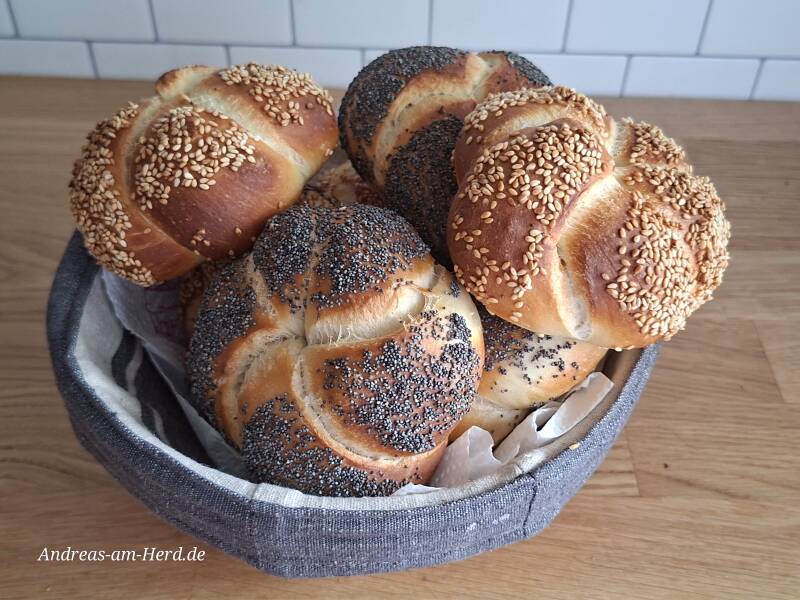
Ingredients: Makes 14 rolls, 90 g each
At least 48 hours before baking:
'Pate Fermente' - 100 g Manitoba flour - 65 g cold water - 1 g active dry yeast - 3 g salt Day 1,
8:00 AM Sourdough Stage 1:
- 20 g sourdough starter - 50 g warm water - 50 g Manitoba flour Mix everything together to form a smooth batter and let it ferment, covered, for 8 to 10 hours.
Day 1, 6:00 PM, Cooked Dough:
- 35 g all-purpose flour (type 550) - 100 g boiling whole milk. Pour the milk over the flour, stir, and cover with plastic wrap. Let cool.
Day 1, 6:00 PM Sourdough Stage 2:
- the dough from Stage 1 - 60 g warm water - 100 g Manitoba flour Mix everything well and cover again. Let it ferment in the kitchen for 12 hours.
Day 2, 6:00 AM, Sourdough Stage 3:
- The dough from Stage 2 - 150 g warm water - 150 g Manitoba flour. Combine all ingredients and let ferment, covered, for 3-4 hours. Many small bubbles should be visible. ... 10:00 AM, Main Dough - 200 g Manitoba flour - 160 g all-purpose flour (type 550) - 1 egg (medium/large) - 20 g apple cider vinegar - 20 g sugar - 15 g baking enzymes (optional)- 4 g active dry yeast - 15 g salt - 20 g softened butter - 35 g cold water (bassinage) Knead all ingredients except the salt together. After about 5 minutes, add the salt and knead until the dough completely pulls away from the sides and bottom of the bowl. Then knead in the butter. Place the dough in a lightly oiled proofing container. Let the dough rest for 90 to 120 minutes, stretching and folding it 3 times during this period. Degas the dough on a work surface and divide it into 14 equal pieces, then shape them into rounds. Let the dough rounds rest for 20 minutes. Dip a dough stamp in cornstarch, then press it firmly onto the dough round. Moisten the surface and press firmly into the seeds. Place the dough balls, seeded side down, on a floured baker's linen. Let them rise for 60 minutes. Meanwhile, preheat the oven to 250°C (480°F) using conventional oven settings (top and bottom heat). Carefully turn the dough balls over and place them on a baking sheet lined with parchment paper. Place the baking sheet in the oven and steam. Reduce the temperature to 210°C (410°F). Bake for approximately 15-18 minutes.
My Hamburg Rolls
Do you know those delicious rolls from Germany? Crispy on the outside and wonderfully soft and full of flavor on the inside! With a 3-stage sourdough starter 60% hydration
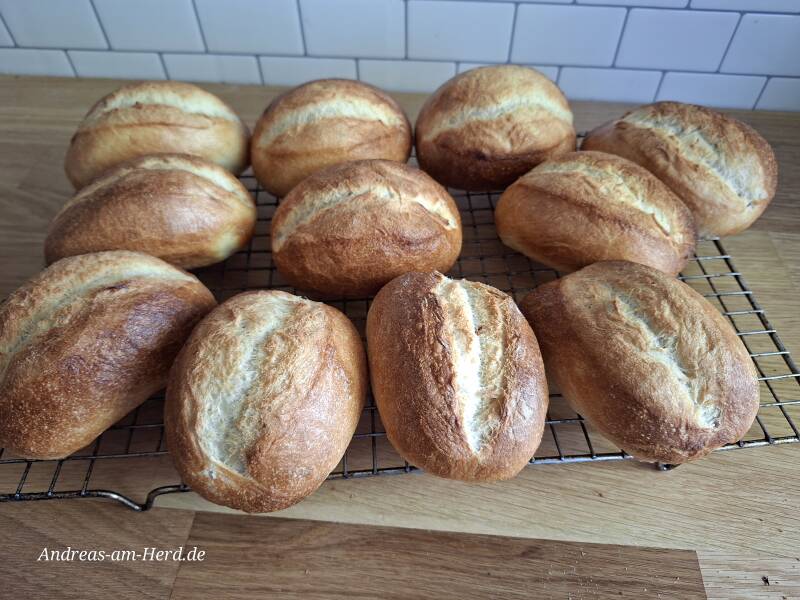
Recipe for 14 rolls, 95 g each
Day 1, 8:00 AM Sourdough Stage 1: - 20 g Levito Madre - 50 g warm water - 50 g All-purpose flour Mix everything together to form a smooth batter and let it stand. Day 1, 8:00 PM Sourdough Stage 2: - the batter from Stage 1 - 60 g warm water - 100 g Bread flour Mix everything well and let it ferment, covered, for 12 hours in the kitchen. Day 2, 8:00 AM Sourdough Stage 3: - the batter from Stage 2 - 150 g warm water - 150 g Bread flour Mix all ingredients and let it ferment, covered, for 3-4 hours. Many small bubbles should be visible. 11:00 AM, Autolyse Dough: - 500 g Bread flour - 16 g baking enzymes - 6 g active dry yeast - 100 g cold whole milk - 120 g cold water - 10 g apple cider vinegar - 10 g honey - 20 g weiche Butter Combine the flours with the baking enzymes and yeast. Add the honey and liquids only at this stage. Mix lightly so that no loose flour remains. Let it rest for 60 minutes. 12:00 PM, Main Dough Sourdough and Autolyse Dough - 15 g salt Knead all ingredients except the salt. After about 10 minutes, add the salt and knead until the dough completely pulls away from the sides and bottom of the bowl. Place the dough in a lightly oiled proofing container. Let the dough rest for 90 to 120 minutes, stretching and folding it 3 times during this period. 1:30 PM Degas the dough on a work surface and divide it into 14 equal pieces. Shape each piece into a ball and then slightly oblong. Let the dough pieces rest for 20 minutes. Press them lengthwise with your fingers almost to the bottom. Then lift them up, gently pinching them together. Place them seam-side down on a floured linen cloth and let them rise for 60 minutes. Carefully turn the dough pieces over and place them on a baking sheet lined with parchment paper. Preheat the oven to 250°C (480°F). Place the baking sheet in the oven and create plenty of steam. Reduce the temperature to 220°C (425°F). Baking time: 15 to 20 minutes
Baguette Rolls

Makes 10 rolls (105 g each)
Morning Sourdough
- 50 g Levito Madre
- 100 g Water
- 130 g 550 Wheat Flour
Pre-Dough
- 100 g 550 Wheat Flour
- 100 g Water
- 1 g Dried Yeast
- 5 g Honey
Prepare the sourdough and pre-dough the evening before, then leave covered in the kitchen.
On Baking Day Cooking Piece
- 30 g 550 Wheat Flour
- 100 g Water
In a small saucepan, bring the flour and water to a boil, stirring constantly, until it reaches a pudding-like consistency. Transfer to a small bowl and cover with plastic wrap. Refrigerate to cool.
Main Dough
- 270 g 550 wheat flour
- 70 g whole wheat flour
- 50 g milk
- 12 g baking enzymes
- 6 g dry yeast
- Add both pre-doughs and sourdough starters and knead the dough
- 14 g salt (add after about 5 minutes)
- Knead in 20 g butter at the end of the kneading time.
Place the dough in a lightly greased dough pan and let it rise at room temperature for 90 to 120 minutes,
stretching and folding it twice.
Shape into 120 g rolls and let them rise for about 30 to 60 minutes, seam-down, in a linen cloth dusted with plenty of rye flour.
Place the rolls on a baking sheet with the seam facing up.
Preheat oven to 250°C and bake at 230°C with plenty of steam for about 15-20 minutes.
American Sourdough Bagel
I've loved this American bread for decades, even though it doesn't actually come from the USA. In San Francisco, one of the most expensive cities in the US, there are small shops that sell only bagels, in countless different varieties. A generously filled bagel to go costs just over $5. That's a bargain by local standards
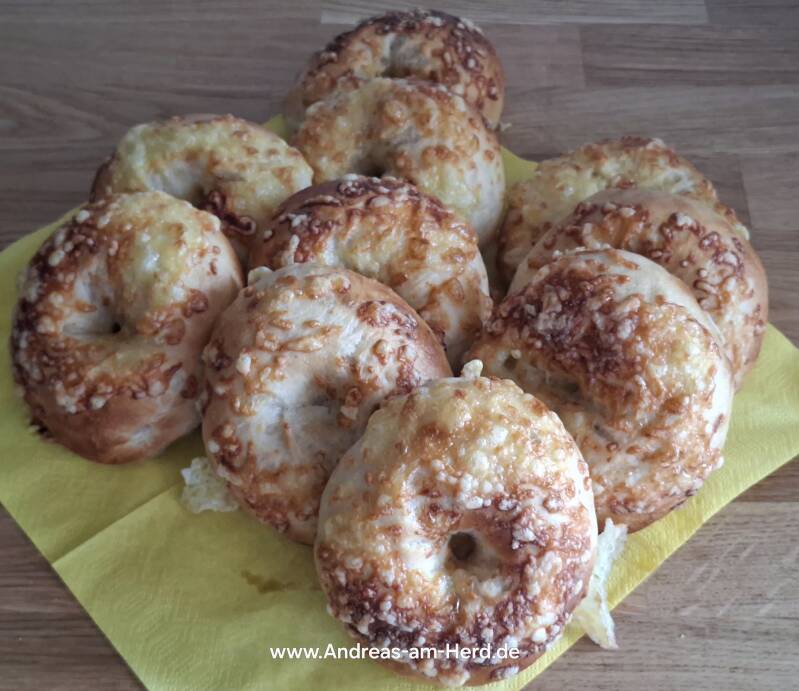

My Favoriten Sunday Morning Breakfast
I calculated the following recipe for 8 bagels.
They'll just barely have enough room on the baking sheet.
My "rolls with the hole" are so incredibly delicious and soft, making the effort of cooking the dough worthwhile!
Sourdough
- 30 g Levito Mamma
- 70 g Water
- 100 g 550 Wheat Flour
Cooking dough:
- 30 g Wheat Flour
- 100 g 3.5% Whole Milk
Mix the flour and milk in a small saucepan, stirring constantly until a pudding-like consistency forms.
Transfer to a small bowl, cover with plastic wrap, and refrigerate to cool.
Pre-dough:
- 100 g 550 wheat flour
- 1 g dry yeast
- 5 g honey
- 100 g cold water
Prepare the pre-dough and sourdough starter and let it rise, covered, for 12 to 18 hours.
This step isn't actually necessary when making bagels.
However, I think the improved flavor the bagels develop is worth the effort.
If you want to save yourself the effort, please include the ingredients listed above below.
Main Dough:
- 270 g 550 wheat flour
- 80 g cold water
- 30 g sugar
- 10 g baking enzymes
- 12 g salt
- 6 g dry yeast
- 2 tbsp. oil
1 tbsp. honey
Knead the ingredients into a smooth dough that easily pulls away from the sides of the bowl.
Let the dough rise for 60 to 90 minutes, stretching and folding it twice.
Divide the dough into 8 pieces. First, roll the dough pieces into rounds, then shape them into a long circle.
Line a baking sheet with parchment paper and sprinkle with semolina flour.
Place the dough pieces on the sheet and let rise, covered, for 45 minutes. In the meantime,
bring water with a little honey to a boil. Add the bagels, one at a time, to the boiling water.
Cook for 45 seconds on each side.
Remove from the oven and place on the parchment paper.
Brush with egg yolk and sprinkle with cheese or seeds (if desired).
Bake in a preheated oven at 180°C (convection oven) for about 17 minutes.
My Danish Poppy Seed and Sesame Seed Rolls
On my last vacation in Denmark, I happened upon a YouTube video by Mikkels Mad.
Even though I don't speak Danish at all, I was immediately very intrigued. So I had to try it, and I was thrilled.
Although I obviously didn't have the equipment (he used a kind of makeshift fermentation chamber) like Mikkels Mad's, I was thrilled with the result.
Once home, I further developed the recipe for myself. I'm extremely grateful to "Mikkel" for the idea.
I use a pre-dough, a cooking dough, and fresh Levito Madre instead of dried sourdough. I'm also not using a fermentation box at the moment. In the summer, it's not absolutely necessary, as the kitchen is warm enough. In the winter, I'll use a fermentation box again, as it significantly shortens the fermentation time.
The most important thing is that these rolls have the bakery quality I experienced with mine and have never found again.
Now I bake them at least once a week.
I especially like it when my rolls crack open nicely on top. They're extra crispy when baked.
I usually use a baguette pan to bake my rolls. This has the advantage that, with soft dough, they don't spread out, but instead rise nicely.

The recipe is for 12 rolls, approximately 85 g each.
Pre-dough:
- 100 g 1050 wheat flour
- 1 g dry yeast
- 100 g cold water
Mix everything until lump-free.
Cooking dough:
- 50 g 550 wheat flour
- 125 g boiling water
Pour the boiling water onto the flour and mix well.
Cover with cling film, directly on the surface.
Caution: It's hot!!!
I prepare both the night before and let them stand in the kitchen until the next morning.
Main dough:
First, weigh the dry ingredients and mix well.
- 450 g 550 wheat flour
- 7 g dry yeast
- 12 g baking enzymes or malt (can be omitted)
- 12 g salt
- 10 g sugar
- 40 g Levito Madre
- 100 g lukewarm 3.5% whole milk
Dissolve the Levito Madre in the milk...
together with the two pre-doughs in the mixing bowl.
Knead everything into a smooth dough that completely pulls away from the sides of the bowl.
Carefully add up to 35 g of remaining water until you reach 60% liquid.
Once the dough is well kneaded, gradually add 15g of softened butter.
Knead in the food processor for approximately 15 minutes.
When the dough starts to pull away from the sides of the bowl, remove it and place it in a lightly oiled dough bowl and let it rise for approximately 40 minutes.
Place the dough on a lightly floured work surface.
Divide the dough into equal 80g pieces. First, roll into a round shape, then slightly stretch it out. Lightly moisten the top and roll in the seeds. Line a baguette pan with baking paper and place the dough pieces on it, leaving enough space between them. In summer, I let the rolls rise for approximately 1 hour, covered with plastic wrap.
In the meantime, preheat the oven to 250°C, add the rolls, reduce the temperature to 220°C, and bake with plenty of steam for about 17 minutes. Release the steam after 4 minutes.
4 minutes before the end of the baking time, switch the oven to bottom heat to ensure the rolls are crispy on the bottom.
My Quick, Rustic Potato Rolls
So much more than just using up leftover potatoes 🥔. These rolls are so flavorful. You should definitely try them!
I'll show you here the quick version without a pre-dough.
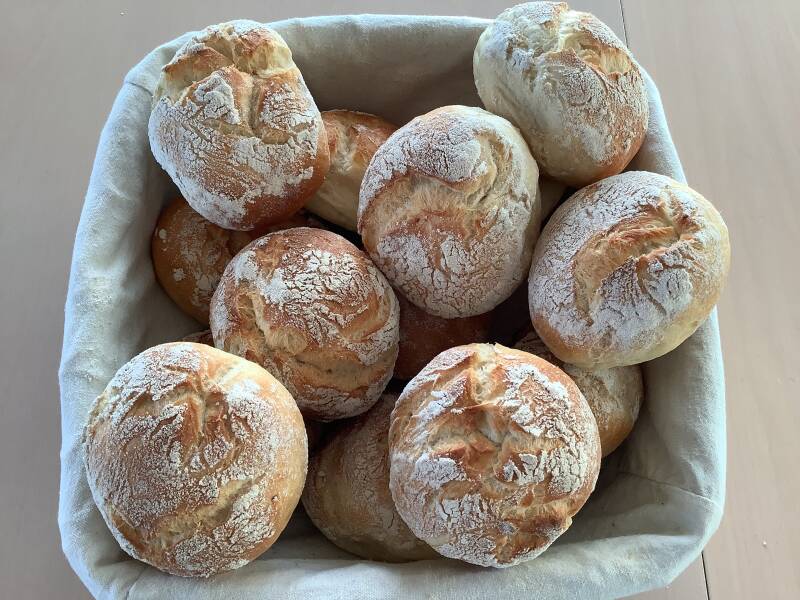
Preparation:
450 g Manitoba flour, high-protein wheat flour
250 g 550 wheat flour (bread flour)
50 g Levito madre flour
15 g baking enzymes (can be omitted)
10 g dry yeast
15 g salt
220 g cooked potatoes (mashed)
300 g cold water
70 g milk (3.8% fat)
30 g softened butter
We make an autolyse dough.
To do this, we mix the flours with the baking enzyme and the liquid,
and let stand, covered, for 60 minutes.
Then, knead all the remaining ingredients, except the salt and butter. After about 5 minutes, add the salt. When the dough completely pulls away from the sides of the bowl, knead in the butter in small pieces. Knead for about 15 minutes.
Once the dough is kneaded, place it in a lightly oiled dough pan.
Let it rest for approximately 60-90 minutes, stretching and folding it every 30 minutes.
Place the dough on a lightly floured work surface, degas, and divide it into 16 90g pieces. Carefully roll the dough pieces into rounds. The ends shouldn't close tightly so that the rolls open nicely in the oven. To do this, press the ends into rye flour. Place them on a baking sheet with the ends facing down and let them rise for 30 minutes.
In the meantime, preheat the oven to 250°C (482°F). Place the rolls in the oven, apply steam, and reduce the temperature to 200°C (402°F).
Baking time: 20 minutes
Potato and Herb Rolls
Adapted from Marcel Paa, another great recipe from my favorite YouTuber!
I liked the idea, but I tweaked it a bit to suit my taste.
The result is rolls with a wonderful aroma, a wonderful crust, and a fluffy, soft interior.
While baking, a wonderful aroma, reminiscent of pizza, spreads throughout the apartment.
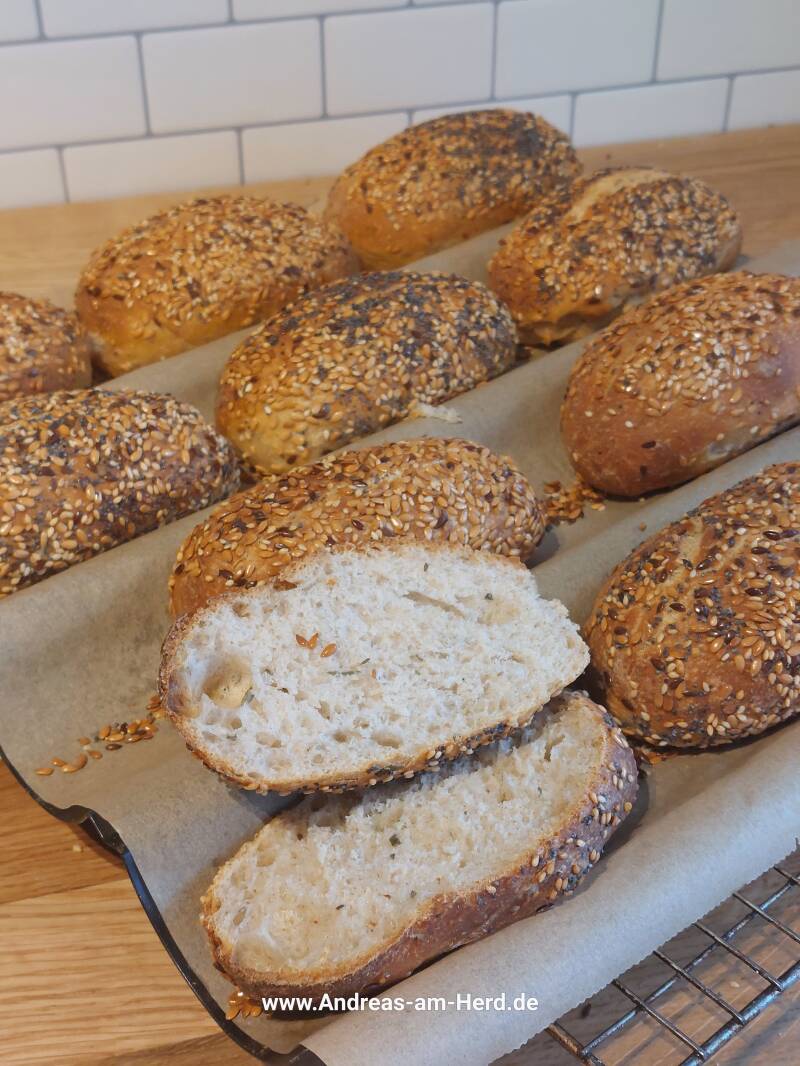
Recipe for 11 rolls (90 g each)
The night before: Sourdough starter: 40 g Levito Madre, 20 g warm water, 40 g Type 550 wheat flour
Pre-ferment: 100 g Type 550 wheat flour, 1 g dry yeast, and 100 g cold water Cooked flour paste (tangzhong): 30 g wheat flour and 100 g boiling milk On
Baking day:
Main dough:
- Sourdough starter, pre-ferment, and cooked flour paste - 330 g Manitoba flour - 200 g cooked, mashed potatoes - 10 g baking enzymes (optional) - 5 g dry yeast - 30 g cold water - 30 g olive oil - 15 g salt - Fresh rosemary and thyme
Seed mix of your choice for topping; I used: sesame seeds, poppy seeds, and brown and golden flaxseeds
Preparation
Mix the flours with the baking enzymes, salt, and dry yeast. Only then add the pre-ferments, potatoes, olive oil, and water. Be a bit cautious with the water and do not add it all at once, as every flour is different and the moisture content of the potatoes varies. Knead everything into a smooth dough; this takes about 12–15 minutes. Once the dough pulls away completely from the sides of the bowl, add the chopped herbs. Place the finished dough into a lightly oiled container and let it rise, covered, for 60 minutes. Then, place the dough in the refrigerator overnight for a cold ferment. On the day of baking, remove the dough from the refrigerator and let it come to room temperature for approximately 60 minutes. On a lightly floured work surface, degas the dough and divide it into 11 equal pieces weighing 90 g each. Shape the dough pieces into rounds first, then form them into an elongated shape. Moisten the surface with a little water and roll in the seed mixture. Then place them in a baguette pan, cover, and let proof for 45 minutes. Preheat the oven to 250°C (convection). Place the rolls in the oven and steam well. After 5 minutes, reduce the temperature to 210°C. Baking time: approx. 20 minutes.
My Onion Rolls
These rolls are simply amazing. Even as they bake, a captivating aroma wafts out of the oven. Even when cooled, they exude a wonderful aroma when cut open. They're crispy on the outside and wonderfully soft on the inside.
My tip: as with almost all homemade rolls, these taste especially good when you put them straight from the freezer into the oven.
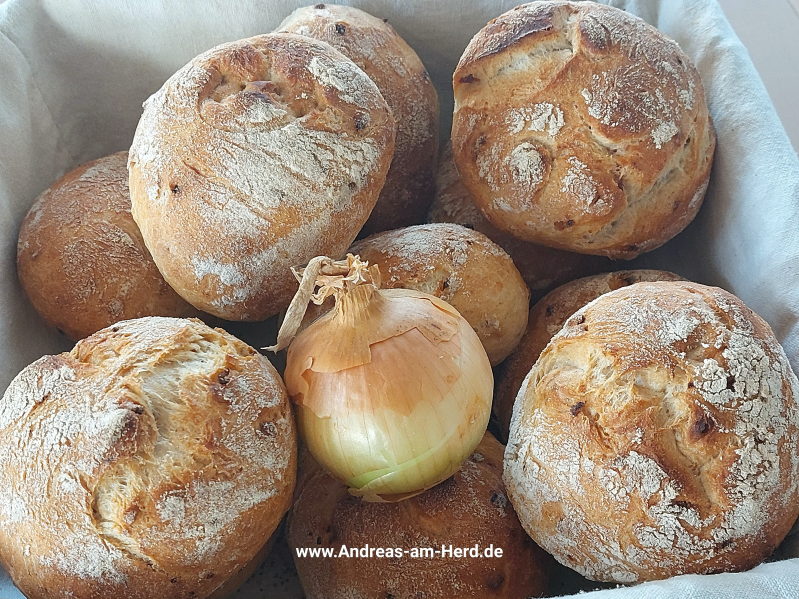
This recipe yields 11 rolls, each 95g.
Pre-dough:
200g Manitoba flour
1.5g dry yeast
200g cold water
Sourdough:
30g Levito madre
70g very warm water
100g 550-grade wheat flour
Prepare both pre-doughs on the day of baking and let them stand, covered, in the kitchen for
12 hours.
On the day of baking:
The two pre-doughs:
150g Manitoba flour
150g 1050-grade wheat flour
12g baking enzymes
7g dry yeast
11g salt
50g milk
70g water
25g softened butter
50g fried onions
Preparation:
Place all ingredients except the salt, butter, and fried onions in a food processor and knead. After 5 minutes, add the salt. When the dough completely pulls away from the sides of the bowl, gradually add the butter. When it pulls away from the sides of the bowl again, add the fried onions.
Total kneading time: approx. 15 to 17 minutes
Place the dough in a lightly oiled dough bowl and let it rise for approximately 90 minutes, stretching and folding it every 30 minutes.
After the dough has rested, transfer it to a floured work surface, degas it, and divide it into 12 pieces of 90g each.
Roll the dough pieces into rounds and place them seam-down on a floured dough cloth. Let rise for 40 minutes.
In the meantime, preheat the oven to 250°C (fan/convection oven).
Turn the dough pieces over and place them on a baking sheet lined with parchment paper.
Place in the oven, steam thoroughly, and reduce the temperature to 210°C (425°F).
Baking time: approx. 20 minutes
Pandesal, the soft, slightly sweet wheat roll from the Philippines
What would a Sunday morning be without my favorite rolls? Pandesal are soft, slightly sweet milk rolls. Together with a little Butter and sliced Mango, it's for me the perfect Breakfast on a Sunday Morning! They always remind me of my trips to the Philippines. There, you can buy them at the bakery for just a few pesos each. They taste best when still lukewarm.
Warning: Addiction!
Ingredients:
- 400 g 550 wheat flour
- 250 g whole milk
- 60 g sugar
- 8 g salt
- 4 g dried yeast
- 2 large egg yolks
- 30 g butter
- 20 g apple cider vinegar
- A little breadcrumbs.
Mix all ingredients, except the butter, into a soft dough.
Shortly before the end of the kneading time, knead in the butter.
Place in a dough bowl, cover, and let rise for about 2 hours. Stretch and fold twice.
Then divide the dough into 15 equal pieces, shape them into balls. Roll them in breadcrumbs, and place them in a baking dish lined with parchment paper. Make sure there's some space between the balls.
Cover and let rise in the refrigerator for about 12 hours.
The next morning, remove the pan from the refrigerator and let it acclimatize for at least 30 minutes.
Preheat the oven to 180°C (top and bottom heat).
Place the pan in the oven and bake for about 25 minutes.
My Hamburg Franzbrötchen - you cannot translate it
A pastry from my hometown of Hamburg
These are my absolute number one roll. They're addictive for me. Unfortunately, they're high in calories, as they contain a lot of butter. Not for dieting, but whatever, they're simply delicious. If you bake this recipe, the whole house will smell of cinnamon!
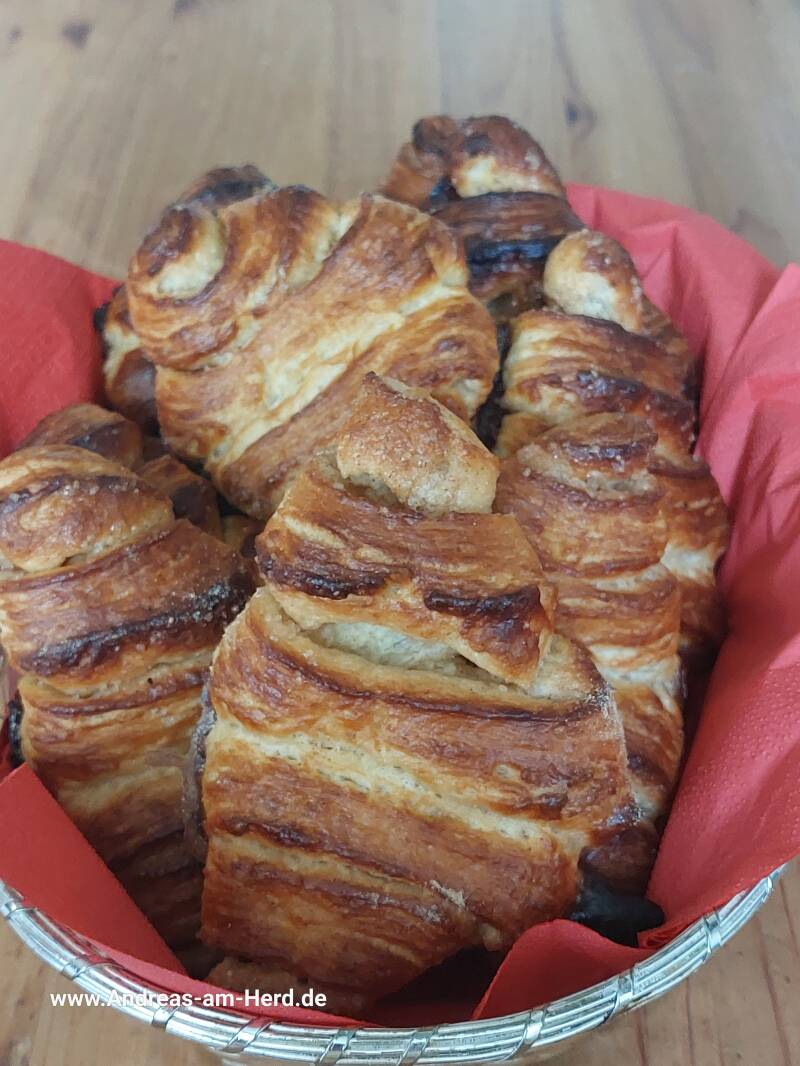
Dough for 10 Franzbrötchen
Daffodil Dough:
- 700 g 550 wheat flour
- 50 g Levito Madre
- 200 g whole milk
- 200 g water
- 70 g sugar
- 5 g dried yeast
- 10 g baking enzymes
- 50 g cold butter
- 15 g salt
- Egg wash (1 egg, a little milk)
For the butter slab:
- 250 g branded butter (no added oil)
Roll out the butter on baking paper into a rectangle.
For sprinkling: brown sugar and cinnamon
Briefly mix all ingredients into a rough dough. Roll out the still-rough dough on a floured surface. Place the butter slab on the bottom half of the dough. Fold over the top half. Press the edges firmly together.
Now roll out the dough once and then fold it like a letter.
Now place the dough in the refrigerator and chill for 45 to 60 minutes.
Repeat this process at least 2, preferably 3 times. Make sure the dough is always placed with the narrow side facing forward, i.e., always rotated 90 degrees. Then refrigerate the dough overnight.
The next morning, roll out the dough to a size of
70 x 30 cm. Sprinkle with a sugar and cinnamon mixture.
Cut into 5 cm wide strips using a pizza cutter and roll them tightly. Press the dough rolls lengthwise in the middle with the handle of a wooden spoon. Place them on a baking sheet, leaving enough space between them, and let them rise for about 1 hour.
Preheat oven to 210 °C (top and bottom heat).
Brush with egg wash and finish baking in the preheated oven.
Baking time: approx. 17 minutes
Meine wunderbaren Roggen-Mischbrötchen
I had been looking for a rye roll recipe that met my standards for quite some time. I tried out a few different ones but wasn't happy with the results. Then, a few days ago, I developed this recipe. I’m really pleased with it! They are crispy on the outside and wonderfully soft on the inside—and they smell amazing! But be warned: doughs containing rye flour can be tricky to handle. Even though this recipe uses only 150 g of rye flour, the dough is very sticky. So, make sure to use plenty of flour on your work surface. But the effort is definitely worth it.
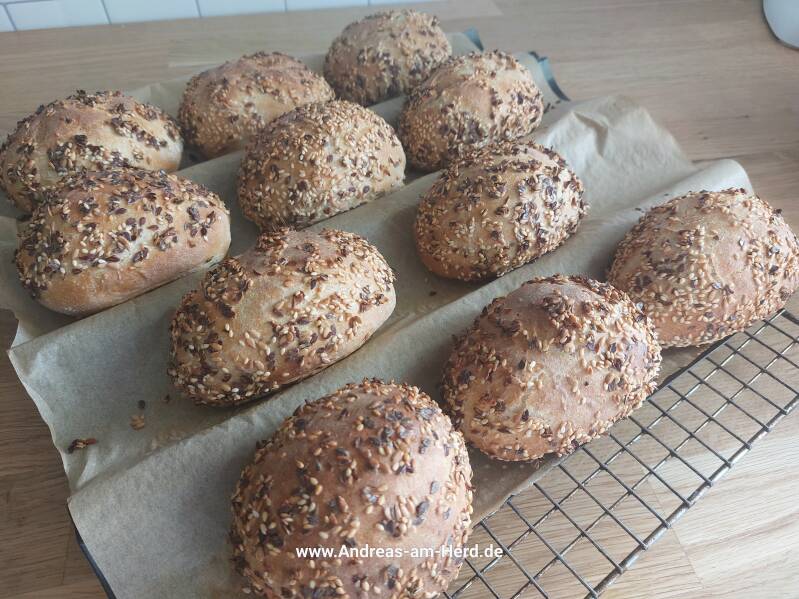
Makes 11 rolls, approx. 80 g each
Sourdough:
- 30 g Levito rye flour
- 100 g warm water
- 100 g rye flour
Pre-dough:
- 100 g 550 wheat flour
- 1 g dry yeast
- 100 g cold water
Prepare both the evening before and let stand in the kitchen for 12 hours.
Cooking dough:
- 30 g 550 wheat flour
- 100 g boiling water
Must cool completely before further processing.
Main dough
- 50 g rye flour
- 270 g 550 wheat flour
- 8 g dry yeast
- 12 g baking enzymes
- 12 g salt
- 10 g sugar
- 30 g cold milk
- 20 g softened butter
Grain mix as desired
On baking day:
- Mix all dry ingredients, except the salt, thoroughly.
- Add the pre-dough, the cooking powder, and the milk.
- Knead everything into a soft, smooth dough. After about 5 minutes, add the salt.
- When the dough starts to pull away from the sides of the bowl, add the butter in small pieces. When the dough has completely absorbed the butter, transfer it to a lightly oiled dough bowl.
- Let the dough rest for 60-90 minutes, stretching and folding every 30 minutes.
- Turn the dough out onto a well-floured work surface and degas the dough. Cut off 12 80g pieces of dough, carefully roll them into rounds in rye flour. The ends should still be slightly open. Moisten the rolls on the side with the ends and press them into the grain mixture.
Line a baguette pan with 4 7cm wide holes with parchment paper. Place the dough pieces in the pan, ends facing up. Cover with plastic wrap. [The baguette pan has the advantage that the rolls, with soft dough, won't spread.]
- Let rise for 60 minutes. In the meantime, preheat the oven to 250°C fan/convection oven. - Spray the surface with water.
- Place the rolls in the oven with plenty of steam. Bake for approximately 15-20 minutes. After 10 minutes, open the oven door and release the steam.
- 5 minutes before the end of the baking time, switch to bottom heat to ensure the rolls are crispy on the bottom. Let cool and enjoy.
Materials needed: - Food processor - Digital scale - Dough scraper - Dough scraper - 2 bowls for moistening and for the seed mixture - Baguette pan - Parchment paper
My Danish Beer Sticks
Why Danish? On our last vacation in Denmark, on a stormy afternoon on the North Sea coast, with a steaming cup of tea, I searched the internet for new recipes! There were several bread recipes with beer. Interesting, but as always, I had to tweak everything and create something new.
So, first thing in the evening, I made a pre-dough. The next morning, I unpacked the KitchenAid. Yes, I'm that crazy 😂 and, along with my lovely wife, I'm also taking my food processor and my flour with me to Denmark. Since I haven't bought bread/rolls for a long time.
Without self-praise, the result was something that tasted really great.
They're especially suitable for a hearty dinner or barbecue.
And the whole holiday home was filled with the scent!
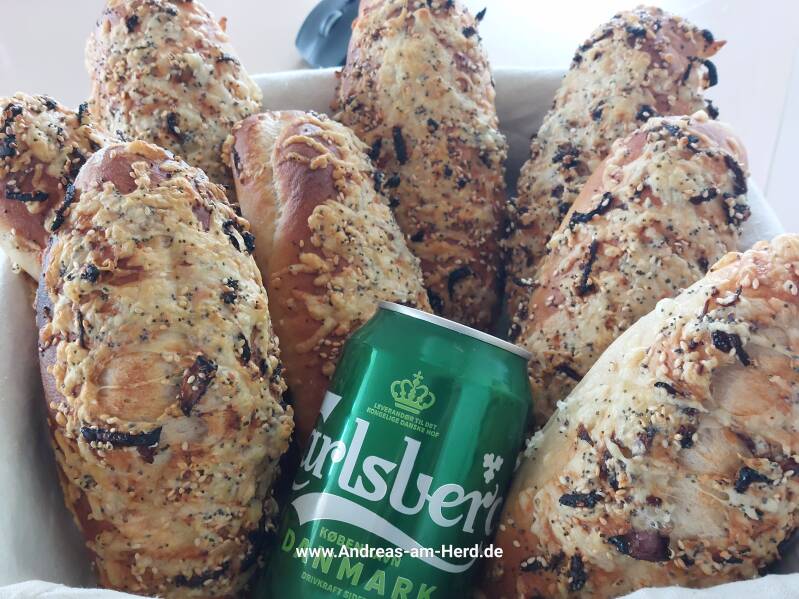
Pre-dough:
- 100 g Manitoba flour
- 50 g 1150 rye flour
- 1.5 g dry yeast
- 150 g beer, in my case Danish beer
Prepare the pre-dough the night before
Main dough:
Pre-dough
- 50 g rye flour
- 100 g Manitoba flour
- 200 g 550 wheat flour
- 30 g Levito madre
- 10 g baking enzymes (can be omitted)
- 6 g dry yeast
- 10 g salt
- 170 g beer 🍺
- 20 g softened butter
Topping:
1 red onion,
- 150 g grated cheese
- sesame seeds, poppy seeds, caraway seeds
- an egg, and a little milk
Preparation:
For the main dough, combine the flours and the baking enzymes and the beer
lightly mix and cover to autolyse for about 1 hour.
Then knead the remaining ingredients, except the salt and butter, into the autolyse dough for about 15 minutes until you have a smooth dough. After about 5 minutes, add the salt.
When the dough completely pulls away from the sides of the bowl, add the butter in small pieces. Once the dough has completely pulled away from the sides of the bowl, transfer the dough
to a lightly oiled dough tray. Let the dough rest for 90 minutes, stretching and folding every 30 minutes.
In the meantime, prepare the topping:
Peel the onion and slice it into thin strips, sauté in a little olive oil until translucent. Let it cool, then mix with the cheese and seeds and set aside.
Place the dough on a floured work surface, degas, and cut into 8 100g pieces. First, roll into a round shape, then shape into a long shape. Let the dough pieces rise in baking cloths for 45 minutes.
Preheat the oven to 250°C.
Carefully turn the dough pieces over and place them on a baking sheet lined with parchment paper. Brush the dough pieces with egg wash and sprinkle with the topping.
Place the Bierstangen in the oven and reduce the temperature to 200°C. Steam the oven.
Baking time: 20 minutes
Tiger Rolls
Why are these rolls called tiger rolls? I think they look more like a leopard!
But no matter, they're simply amazing, nice and crispy on the outside and with a great crumb inside.
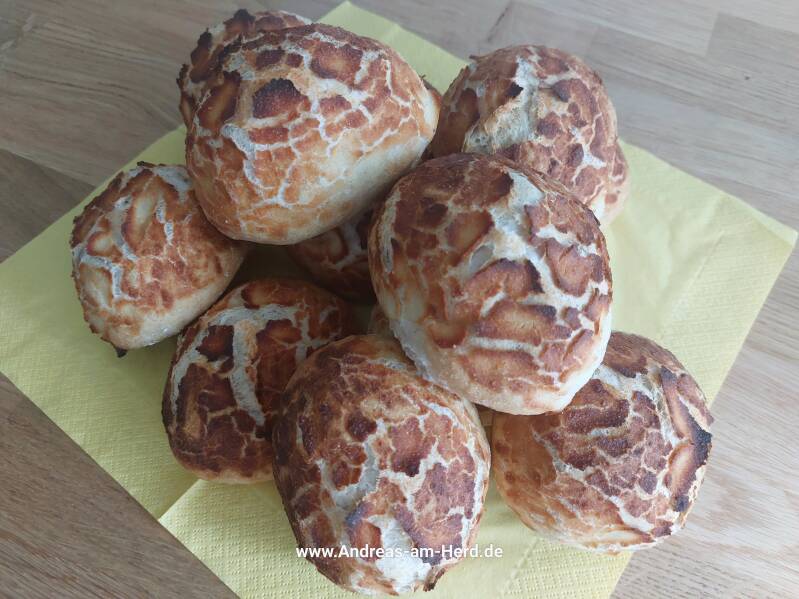
Makes 12 rolls, 80 g each
Pre-dough:
- 100 g type 700 wheat flour
- 1 g dry yeast
- 100 g cold water
Sourdough:
- 30 g Levito Madre
- 70 g very warm water
- 100 g type 700 wheat flour
I prepare both pre-doughs the day before, around 4 p.m., and then let them stand, covered, in the kitchen for up to 18 hours.
Main Dough:
- 350 g 700 wheat flour
- 190 g cold water
- 50 g cold milk
- 11 g baking enzymes
- 6 g dry yeast
- 11 g salt
- 5 g sugar
- 20 g softened butter
Tiger Pranks:
- 100 g rice flour
- 1 g dry yeast
- 5 g each of sugar and salt
- 1 tbsp olive oil
- Let the tiger pranks rise for at least 1 hour.
Knead all ingredients for the main dough, except the butter, into a smooth, soft dough. Knead for approximately 12 minutes. When the dough completely pulls away from the sides of the bowl, knead in the butter in small pieces. When the dough completely pulls away from the sides of the bowl, transfer the dough to a lightly oiled dough bowl and let it rise for 60-90 minutes. Stretch and fold twice.
Place the dough on a lightly floured work surface, degas, and weigh it into 12 80g pieces. Cover and let rise on a baking sheet for about 45 minutes. Place the rolls on a perforated baking sheet lined with baking paper. In the meantime, preheat the oven to 250°C (fan/convection oven).
Brush the dough pieces with Tigerstreiche and place in the oven.
Reduce the temperature to 210°C (425°F) and bake with plenty of steam for about 20 minutes.
My german Rolls
If I bake simple rolls, it's these! They're crispy on the outside, really crispy, and fluffy on the inside. They have a lot of character and aren't those ( bad)nairy rolls you get from some bakeries.
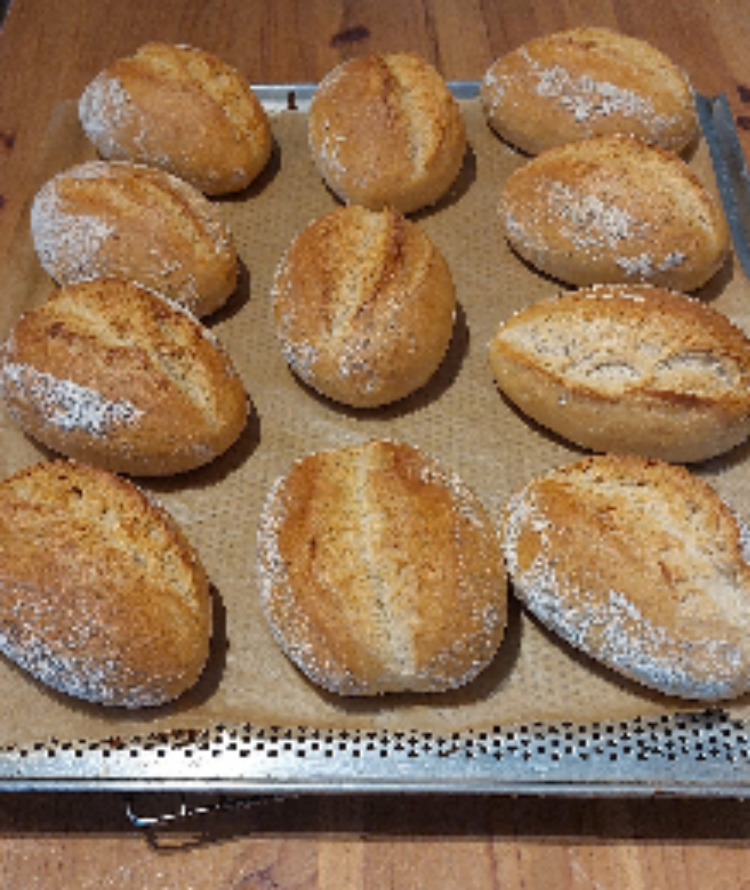
Sourdough:
100 g Levito Mamma,
50 g water
5 g honey
100 g Manitoba flour
Pre-dough:
100 g 550 wheat flour
100 g water
1 g dry yeast
Cooking dough:
50 g 1050 wheat flour
100 g boiling water
Leave all 3 doughs covered in the kitchen for 12-15 hours.
Main dough:
Sourdough, pre-dough, and cooking dough
300 g 550 flour
50 g rye flour
75 g 3.5% milk
100 g water (a little more if necessary)
6 g dry yeast
10 g baking enzyme or malt
14 g salt
30 g butter
A little rye flour for the work surface and for dusting.
Main dough:
For the main dough, combine the dry ingredients, except for the salt.
Pre-dough:
For the main dough, combine the dry ingredients, except for the salt. Then I add the remaining ingredients (except the salt and butter) to the mixing bowl and knead until no dry flour remains, then add the salt.
Knead for a total of 10 to 15 minutes, until the dough completely pulls away from the sides of the bowl, then gradually add the butter in small pieces. When it pulls away from the sides of the bowl, transfer the dough to an oiled bowl and let it rise, covered, for about 90 minutes.
Stretch and fold it 3 times.
Place the dough on a lightly floured work surface and divide it into 12 equal pieces. First, roll the rolls into rounds, then let them rest for 10 minutes.
Roll out the dough pieces long and tightly from the top.
Place them on a baking sheet or tea towel dusted with rye flour, seam down.
Proof for about 45 minutes.
Preheat oven to 250°C (fan).
Place the rolls seam-up on a baking sheet lined with parchment paper and spray with water.
After placing them in the oven, reduce the temperature to 220°C.
Bake with plenty of steam for about 15-20 minutes, or until the rolls are browned to your liking.
Raisin Rolls
Soft, sweet, and delicious! Spread with butter, they're a real treat. Your kids will love them.
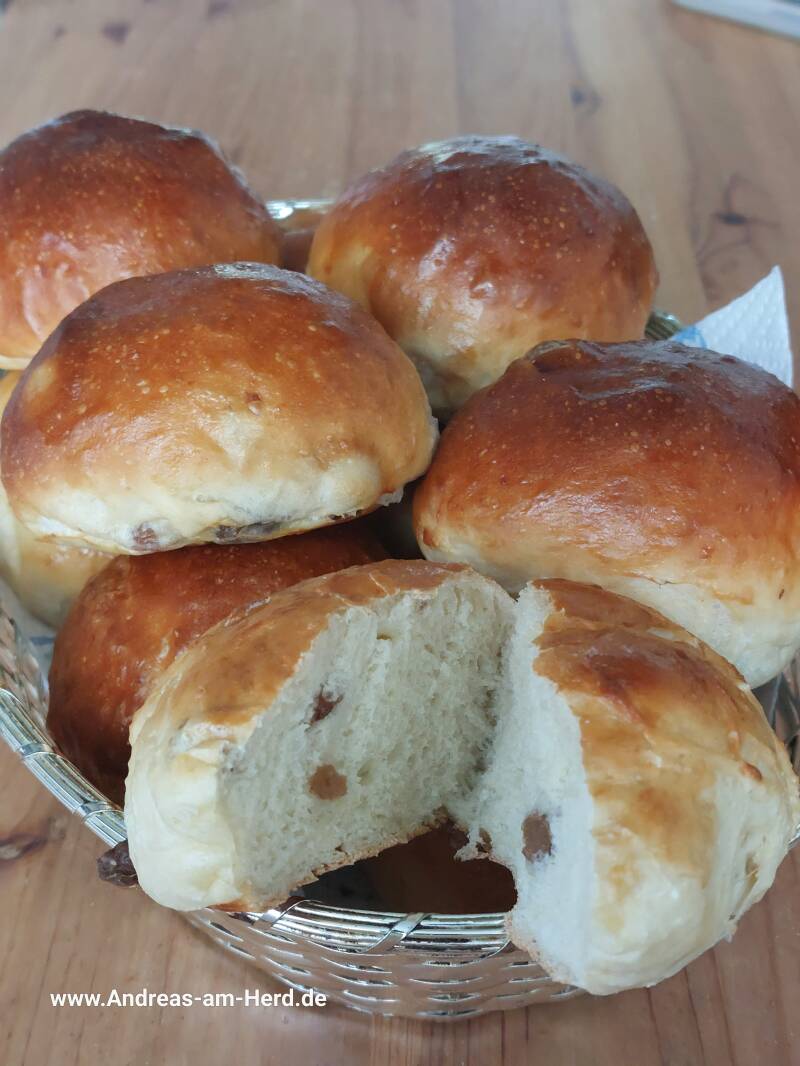
The night before:
Pre-dough:
- 100 g 550-grade wheat flour
- 1 g dry yeast
- 100 g cold water
Cooking dough:
- 30 g 550-grade wheat flour
- 100 g milk
Boil the flour and milk in a small saucepan, stirring constantly, until a pudding-like consistency forms. Transfer to a small bowl and cover with cling film.
----------------
- Soak 75 g of sultanas in 150 g of boiling water.
--------------
The next morning:
Drain the sultanas well and pat dry.
Pre-dough and Cooking Dough
- 370 g 550 wheat flour
- 10 g baking enzymes
- 50 g Levito mamma flour
- 40 g sugar
- 90 g whole milk
- 10 g salt
- 1 egg yolk
- 6 g dried yeast
- 30 g butter
Icing:
- 1 egg, a little milk
Knead the above ingredients, except for the sultanas and butter, into a smooth dough. Just before the end of the kneading time, knead in the butter and only at the very end add the sultanas.
Place the dough in an oiled dough pan and let it rise for approximately 90 to 120 minutes. Stretch and fold it three times.
Place the dough on a lightly floured work surface and divide it into 10 pieces, each about 100g. Shape into rounds and place seam-down on a baking sheet lined with parchment paper. Brush with frosting and let rise for 60 minutes. In the meantime, preheat the oven to 210°C. Brush with frosting again.
Place the rolls in the pan and add steam after about 5 minutes. Bake for approximately 20 minutes.
New wholemeal bread rolls
A new creation of mine: Crispy whole wheat rolls, made with malt beer instead of water as the liquid ingredient.
This gives them a slightly malty flavor that goes very well with the wholemeal dough.
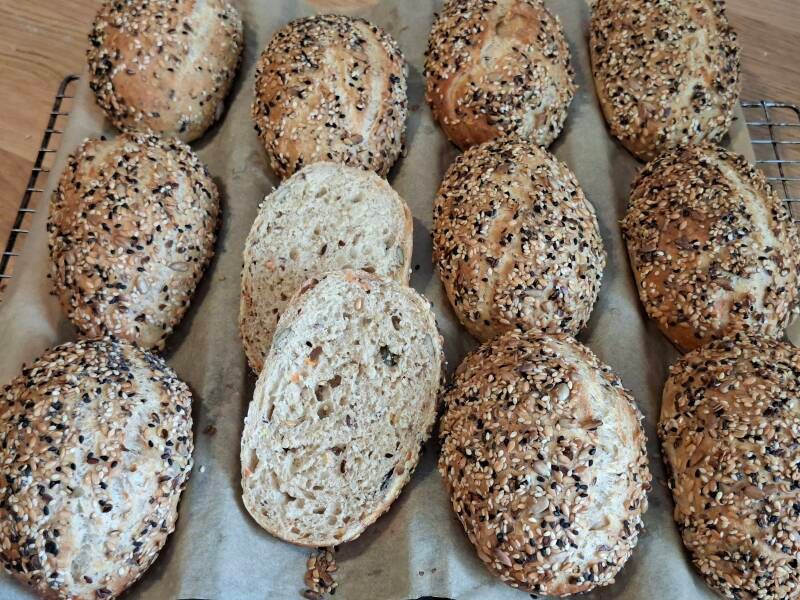
Pre-dough:
- 200 g Manitoba flour
- 200 g malt beer
- 2 g active dry yeast
Prepare the pre-dough 12-18 hours before baking and leave it covered in the kitchen.
Main dough:
- 150 g Manitoba flour
- 100 g wheat flour type 1050
- 100 g whole wheat flour
- 10 g baking enzymes
- 160 g malt beer
- 50 g Levito Madre (sourdough starter)
- 10 g active dry yeast
- 10 g salt
- 20 g sunflower oil
----------------------------
- 50 g grated carrots
- 30 g flax seeds
- 30 g sunflower seeds
- 40 g pumpkin seeds
----------------------------
Topping: Poppy seeds, sesame seeds, flax seeds (golden), sunflower seeds
Preparation:
Autolyse dough
1. Mix the flours, baking enzymes, and beer together. Let it swell for at least 1 hour.
2. Add the Levito Madre, active dry yeast, and salt and knead into a soft dough for about 10 minutes. When the dough completely detaches from the edge of the bowl, add the butter.
3. Finally, knead in the carrots and the seed mixture.
4. Place the dough in a lightly oiled dough container and let it rise for about 90 minutes. Stretch and fold it twice during this time.
5. Degas the dough on a lightly floured surface and divide it into 12 equal pieces. Shape them into rounds, moisten the bottom, and press them into the seed mixture.
6. Place the rolls seed-side down on a floured baker's linen. Proof for 45 minutes. Meanwhile, preheat the oven to at least 250°C.
7. Line a baking sheet with parchment paper. Place the dough pieces, with the seeded side facing up, onto the baking sheet. Place the rolls in the oven and steam them. Reduce the temperature to 210°C and bake for about 20 minutes.
Kiel rolls
I think these rolls are only available in the Kiel area. I first encountered these delicious rolls during my time in the Navy. That was a long, long time ago! A few weeks ago, I discovered the recipe online and, of course, tried it out immediately. They're basically regular rolls that are additionally rubbed in a mixture of butter, lard, and salt. If you don't like lard, you can leave it out. But the taste will be different. They're beautifully crispy on the outside and fluffy and soft on the inside.

Preferment:
- 100 g Manitoba flour
- 1 g active dry yeast
- 100 g cold water
Prepare the evening before, cover, and let stand in the kitchen for 12-15 hours.
Autolyse dough:
- 300 g Manitoba flour
- 100 g all-purpose flour (type 550)
- 10 g baking enzymes
- 100 g cold milk
- 150 g cold water
Briefly mix these ingredients and let them rest for about 1 hour.
Main dough:
- Preferment & Autolyse dough
- 40 g sourdough starter (from the refrigerator)
- 7 g active dry yeast
- 10 g sugar. Knead everything in a stand mixer for about 5 minutes.
- Add 10 g salt. Knead the dough until it completely pulls away from the sides of the bowl.
- Add 20g of softened butter in small pieces and continue kneading until the dough completely pulls away from the sides of the bowl. Knead for about 15 minutes. Place the dough in a lightly oiled proofing container and let it rise for about 90 minutes, or until it has doubled in volume.
Stretch and fold the dough twice during this time.
Degas the dough on a lightly floured work surface, divide it into 11 equal pieces, and shape them into rounds.
Make sure the seam doesn't close completely.
- Mix 30g of softened butter and 30g of lard with a pinch of salt and place it on the work surface, smoothing it out slightly.
Now, carefully rub the dough rounds, seam-side down, in the fat mixture, being careful not to close the seam,
so they will open nicely during baking.
Place the dough rounds, seam-side down, on a well-floured baker's linen and let them rise for 40 minutes.
Preheat the oven to 270°C (525°F). Turn the dough pieces over and place them on a baking sheet lined with parchment paper.
Place in the oven, steam well, and reduce the temperature to 220°C (425°F). Bake for approximately 17 minutes.
Simit - "My Turkish Rings"
Anyone who's ever been to Turkey knows them: simit. Whether in Istanbul, Izmir, or anywhere else along the Turkish coast.
They're eaten there at all times of day, for example, for breakfast or simply as a snack.
They're soft, coated in sesame seeds, and incredibly delicious!
Where I worked for a long time, there were several Turkish grocery stores that sold these tasty treats.
Here, I'm presenting my version of simit, and they're just as good as the original.
Maybe even a little better.
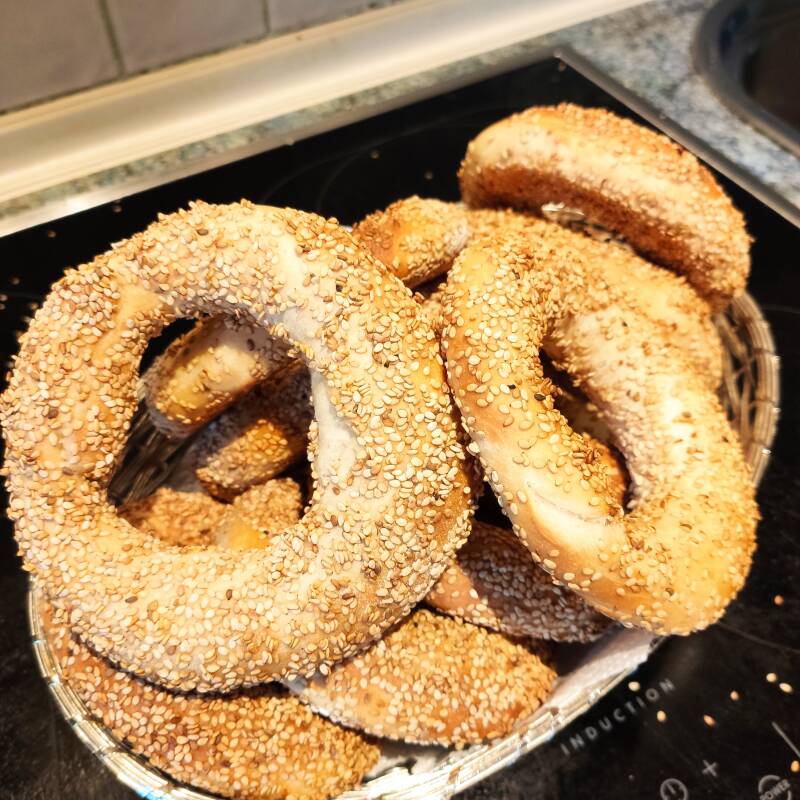
Preparation:
Preferment:
- 100 g Allperpours
- 1 g dried yeast
- 100 g cold water
Sourdough:
- 50 g Levito Madre
- 100 g warm water
- 100 g all-purpose flour (type 550)
Prepare both preferments the day before and leave them covered in the kitchen.
Cooked mixture:
- 40 g all-purpose flour (type 550)
- 100 g whole milk
For the cooked mixture, gently heat the flour and milk in a small saucepan. Stir constantly until a pudding-like consistency is reached. Transfer to a small bowl, cover with cling film,
and let cool. Store in the refrigerator until ready to use.
On baking day:
- 300 g all-purpose flour (type 550)
- 10 g baking enzymes
- 5 g active dry yeast
- 10 g salt
- 50 g sunflower oil
Also:
- 100 g water, 50 g molasses, and approx. 150 g sesame seeds
Combine all ingredients, except the salt, in a food processor to form a soft dough.
Add the salt after about 5 minutes. Knead until the dough completely pulls away from the sides of the bowl.
Place the dough in a lightly oiled proofing container and let it rise for about 90 minutes, stretching and folding it twice during this time.
Divide the dough into 7 equal pieces and shape them into rounds. Let them rest for about 20 minutes.
Now, shape the dough into a long loaf, about 40 cm in diameter, and then into a circle.
Place on a baking sheet lined with parchment paper and let rise for 45 minutes.
Mix the water with the molasses. Dip the rings in the liquid and then roll them in sesame seeds.
Bake in a preheated oven at 220°C (425°F) until golden brown, about 10 minutes.
My fried Potato Rolls
Call me the crazy old man if you want, now I'm even making rolls out of leftovers 😅. I had leftover fried potatoes made from fresh potatoes without bacon or onions. So I just had to try something new, and the result is exceptionally good. It's hearty and very flavorful. Not necessarily something to enjoy with jam, but wonderful for supper with cheese or cold cuts.

Preferment:
100 g Manitoba flour, 1 g active dry yeast, 100 g water. Sourdough: 50 g sourdough starter, 100 g warm water, 100 g type 1050 wheat flour.
Prepare both preferments in the evening and let them rest, covered, in the kitchen.
Main dough (autolyse): 250 g Manitoba flour, 100 g type 1050 wheat flour, 12 g baking enzymes, 10 g sugar, 60 g cold water, 60 g whole milk. Briefly mix the ingredients and let them rest for at least 60 minutes.
For theMaindough preferment, sourdough, and autolyse
200 g leftover roasted potatoes, mashed
20 g fried onions chopped
6 g active dry yeast
25 g lard/butter.
Add a little water if needed (approx. 30 g).
Preparation:
Knead all ingredients except the salt and lard. After 5 minutes, add the salt. Once the dough completely pulls away from the sides and bottom of the bowl, knead in the lard/butter.
– Place the dough in a lightly oiled proofing box and let it rise for 90–120 minutes. During this time, stretch and fold the dough twice.
– Degas the dough on a lightly floured work surface and divide it into 12 equal pieces. Shape each piece into a round roll, taking care not to seal the seam. Place them seam-side down on a floured linen cloth.
– Let them rise for 45 minutes. Preheat the oven to 250°C (convection). – Spray the rolls with water, place them in the oven, and reduce the temperature to 220°C (convection). Bake for about 16 minutes. – Immediately after baking, spray the rolls with water and let them cool.
Worldchampion Potatorolls

Day 1, Afternoon
Preferment:
- 100 g Manitoba flour
- 1 g active dry yeast
- 100 g cold water
Sourdough:
- 40 g sourdough starter
- 70 g warm water
- 100 g wheat flour type 1050
Cover and let it ferment in the kitchen for 8 to 10 hours.
Soaker:
25 g poppy seeds
25 g sesame seeds
25 g flax seeds
40 g sunflower seeds
100 g boiling water
Let it soak for at least 2 hours or overnight
Fermentolysis:
- 250 g Manitoba flour
- 100 g wheat flour type 1050
- 50 g rye flour type 1150
- 100 g cold water
- 14 g salt
Briefly mix and let it soak, covered, in the kitchen for 12 to 18 hours.
Day 2, morning
Main dough:
Pre-ferment, fermentolysis, and scalded dough
- 200 g cooked potatoes (mashed)
- 8 g dried yeast
- 15 g baking enzymes
- 30 g soft butter
Knead the dough until it completely pulls away from the sides of the bowl. Add a little water if necessary, but not too early, as the potatoes will release some moisture. Knead for about 15 minutes. Place the dough in a lightly oiled proofing container.
Day 2, morning
Carefully transfer the dough to a lightly floured work surface and flatten it slightly to about 3 cm, forming a rectangular shape. Sprinkle sunflower seeds onto the work surface and place the dough on top. Press down lightly, turn the dough over, spray with water, and sprinkle with sesame and poppy seeds. Divide into 12 equal pieces and place on a baking sheet lined with parchment paper. Cover and let rise for 60 minutes. Bake in a preheated oven at 250°C for 10 minutes with steam. Reduce temperature to 200°C and bake for another 10 minutes.
All other Bread-Roll Recipes
All the rolls listed here are just as delicious as the other recipes. I just don't bake them as often.
Danish Tebirkes
These wonderfully airy, flaky rolls never cease to amaze me, despite the effort involved. They're made from homemade Danish pastry with plenty of butter.
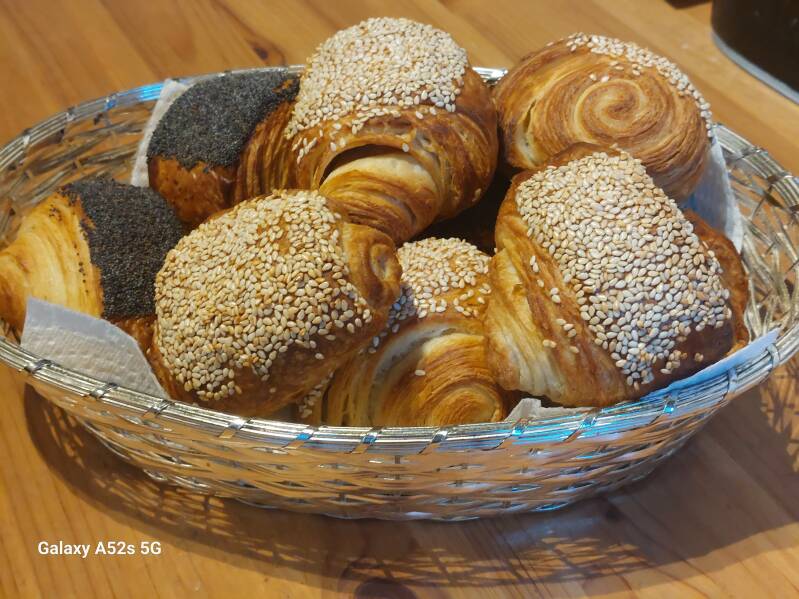
Preparation of the dough:
500 g 550 wheat flour
250 g water
50 g milk
10 g salt
7 g dried yeast
40 g cold butter
180 g butter for the butter slab (please prepare this beforehand)
Roll out the butter with a rolling pin on a floured work surface.
Quickly knead all ingredients together in a food processor. The dough doesn't need to be smooth.
Place the dough on the work surface. Shape it into a rectangle with your hands.
Roll out with a rolling pin to a thickness of 5 mm.
Place the butter slab on the dough, fold it over, and roll out the dough to a thickness of approximately 10 mm.
Fold the dough like a letter. Refrigerate for 1 hour. Place it with the narrow side facing up,
roll it out, and fold it back together. Refrigerate for 1 hour. Repeat this process 2 more times.
Store in the refrigerator until the next morning.
On the day of baking, remove the dough from the refrigerator and roll it out into a rectangle.
Using a pizza cutter, cut it into 8 pieces along the wide sides.
Roll up tightly, spread with icing, and sprinkle with sesame and poppy seeds.
Potato Rolls with Pumpkin Seeds
I've baked potato rolls a few times. They were delicious, too, but never with Levito Madre and rye flour.
We had some mashed potatoes left over after lunch, and I got the idea to create something of my own. The result was quite convincing. Or rather, I'm a little proud of my "invention." This recipe is definitely going on my regular list ☺️
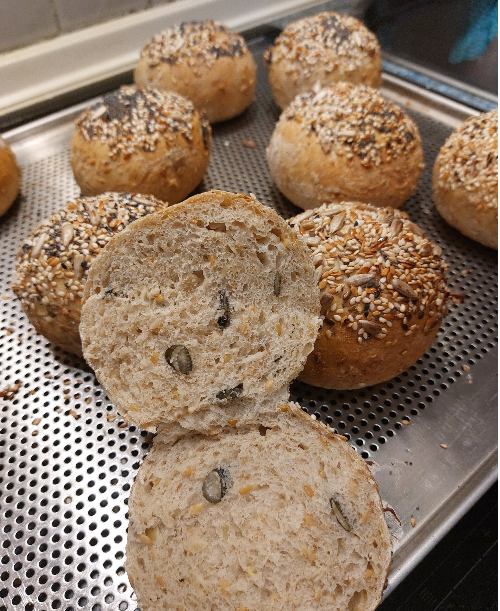
Sourdough:
- 50 g Levito Madre
- 100 g water
- 130 g rye flour (997)
Pre-dough:
- 100 g wheat flour (550)
- 1 g dry yeast
- 100 g water
- 6 g honey
Prepare both pre-doughs the night before and let them stand, covered, in the kitchen for 12-18 hours.
Main Dough:
Sourdough, Pre-Dough, and Cooking Dough
- 270 g 550-grade Wheat Flour
- 75 g 1050-grade Wheat Flour
- 75 g Whole Wheat Flour
- 13 g Salt
- 7 g Dried Yeast
- 12 g Baking Enzymes
- 50 g Pumpkin Seeds
- 100 g Water
- 60 g Milk
- 25 g Butter
(a little water as needed)
Grain Mix for sprinkling.
On Baking Day:
Briefly mix the dry ingredients.
Add the pre-doughs and the usual ingredients, except the butter, and knead for about 12 minutes until a smooth dough forms. When the dough starts to pull away from the sides of the bowl, add the butter in small flakes and continue kneading until the dough has completely absorbed the butter. Place the dough in a lightly oiled dough pan and let it rise for about 90 minutes, stretching and folding it three times.
Place the dough on a floured work surface and divide it into equal 80g pieces. Roll the rolls into balls, lightly moisten them, and press them into the seed mixture.
Place the dough pieces, seam-up, on a well-floured baking sheet.
Cover and let rise for about 60 minutes.
After the dough has risen, turn the rolls over and place them on a baking sheet lined with parchment paper.
Preheat oven to 250°C (fan oven).
Place the rolls in the oven, reduce the temperature to 230°C, and bake with plenty of steam for about 20 minutes.
Korneck
Today I decided to try something new again.
Korneck is a delicious whole-grain roll from a large Hamburg bakery. A triangular roll with whole-grain flour, grated carrots, and various nuts on the inside and seeds on the outside.

Sourdough
- 50 g Levito Mamma flour
- 100 g water
- 130 g rye flour (997)
- 6 g honey
Pre-dough
- 100 g wheat flour (550) or Manitoba flour
- 100 g water
- 1 g dry yeast
Cooking dough
- 50 g whole wheat flour
- 75 g boiling water
Main dough
- Sourdough, pre-dough
- 220 g wheat flour (550)
- 30 g water
- 70 g milk
- 3.5 g dry yeast
- 50 g pumpkin seeds
- 30 g flaxseeds
- 70 g grated carrots
- 12 g salt
- 1 egg yolk
- 30 g butter
- Seed mix according to Choice (in my case: sesame, poppy seeds, flax seeds, sunflower seeds)
The sourdough should be prepared the night before.
On the day of baking, combine all ingredients except the salt, butter, nuts, and grated carrots into a smooth dough.
Knead in the salt after about 3 minutes. Then add the nuts and carrots.
Place the finished dough in a lightly greased dough pan and let it rise for about 2 hours. Stretch and fold it 3 times.
Tip the dough out of the pan onto a floured work surface. Carefully shape the dough into a square with your hands. Cut off the rolls, moisten the dough pieces, and press the tops into the seed mixture. Place on a baking sheet, cover, and let rise for about 1/2 hour.
Preheat oven to 250°C, add the rolls, add steam, and reduce the temperature to 220°C.
Baking time: approx. 17 minutes, after approx. Release steam after 10 minutes.
Baking time: approx. 17 minutes. Release steam after about 10 minutes.
Hamburg Krause Klöben
This is also a pastry from my hometown of Hamburg, but unfortunately, it's no longer available anywhere.
When I was a child, I could buy these delicious pastries from almost every bakery in Hamburg.
Unfortunately, these artisan bakeries no longer exist. Industrial bakeries no longer produce them.
I'd also like to thank Lutz Geissler from "Ploetzblock.de" for rediscovering this recipe.
I will definitely bake these Klöben more often, even if it's a bit more work.
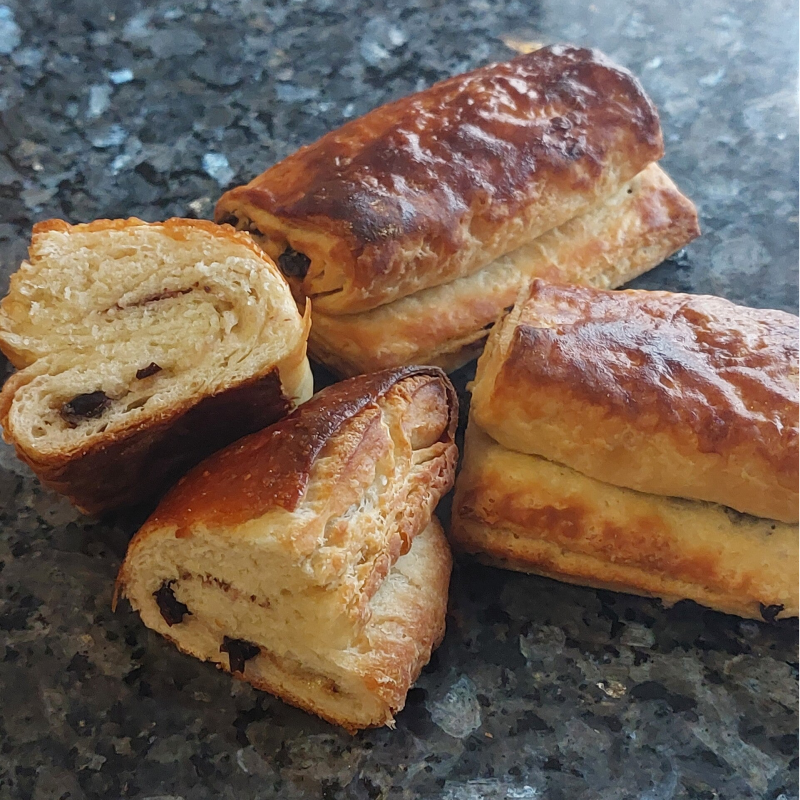
Ingredients for about 12 pieces
I prepare the dough the night before.
- 600 g 550 wheat flour
- 150 g whole milk
- 170 g water
- 60 g sugar
- 10 g dried yeast
- 12 g salt
- 1 g vitamin C
For the butter slab:
- 125 g branded butter
Filling:
- 100 g currants
- 30 g orange juice
Briefly knead the ingredients until they form a dough. Roll out on a lightly floured surface into a square, approximately 30 cm x 30 cm.
Wrap in plastic wrap and refrigerate for 12 hours.
Roll out the butter in parchment paper to a size of approximately 20 x 20 cm. I sprinkle a little flour on the parchment paper so the butter doesn't stick to the parchment paper.
The butter slab also goes into the refrigerator for 12 hours.
Soak the currants in the orange juice.
The next day, roll out the dough on a floured work surface approximately 60 x 30 cm.
Then, double the dough. This means folding the two ends into the middle and then folding over again.
Place the dough in the refrigerator for approximately 45 minutes.
Then roll it out lengthwise again. Sprinkle with the currants and fold the dough into a round.
- Return it to the refrigerator for approximately 45 minutes.
Roll out the dough into a rectangle, approximately 5 mm thick.
Cut into squares approximately 10 x 10 cm. Spray with water.
Fold over once to the middle and place on a baking sheet lined with parchment paper. Cover and let rise for approximately 2 1/2 hours.
Preheat oven to 220°C (top and bottom heat).
Bake the dumplings for about 15 minutes.
Sliced Rolls with Spelt
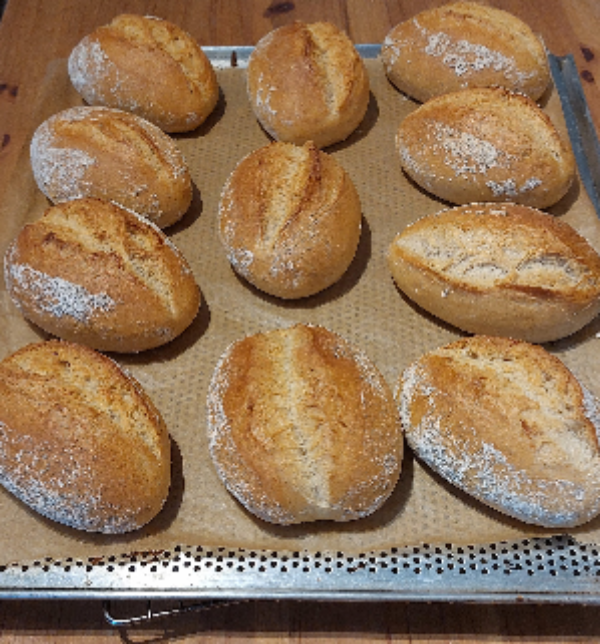
Pre-dough:
- 100 g 630-grade spelt flour
- 100 g cold water
- 1 g dry yeast
- 6 g honey
Pre-dough prepared at 8:00 a.m.
Cooking dough:
- 30 g 630-grade spelt flour
- 100 g water
Bring the flour and water to a boil in a small saucepan, stirring continuously until a pudding-like consistency develops. Transfer to a small bowl, cover, and refrigerate to cool.
Main dough: Afternoon around 4:00 p.m.
- both pre-doughs
- 250 g 630-grade spelt flour
- 100 g 1050-grade spelt flour
- 10 g baking enzymes
- 50 g LM, straight from the refrigerator
- 100 g water
- 5 g dry yeast
- 30 g butter
Briefly mix the dry ingredients.
Add the pre-doughs and the usual ingredients, except the butter, and knead for about 12 minutes until you have a smooth dough. When the dough starts to pull away from the sides of the bowl, add the butter in small pieces and continue kneading until the dough has completely absorbed the butter.
Place the dough in an oiled bowl or dough sheet and let it rise for
90 to 120 minutes, stretching and folding it twice.
Shape the dough into 10 rolls. First, roll it into a round shape, then shape it into a long shape.
Let them rise in a baking cloth with the seams facing down for about 45 minutes.
Preheat oven to 250°C. Place the rolls on a baking sheet with the seams facing up, cut a hole, and spray with water.
Place the rolls in the oven, reduce the temperature to 220°C, and bake with plenty of steam for about 18 minutes. Release the steam after 10 minutes.
Healthy whole grain rolls
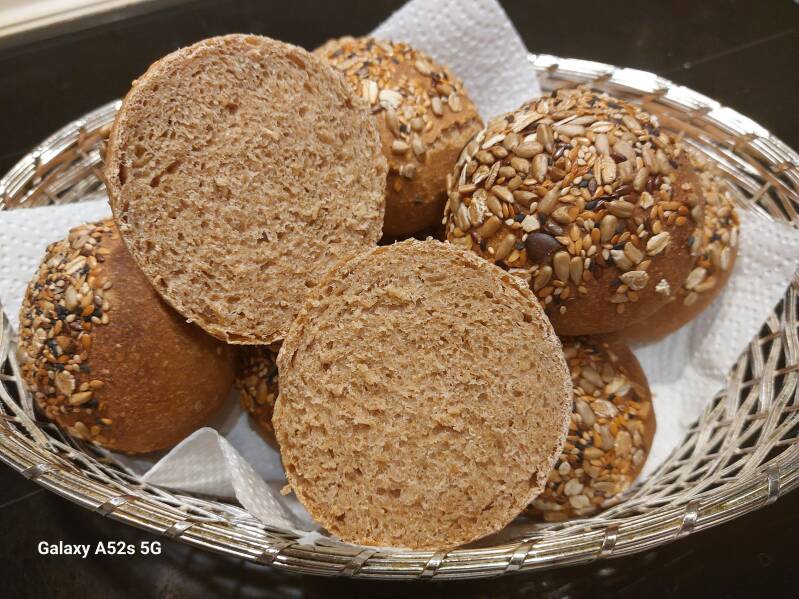
Cooking dough:
- 50 g whole wheat flour
- 130 g water
Bring the flour and water to a boil in a small saucepan, stirring constantly, until a pudding-like consistency develops. Transfer to a small bowl, cover, and refrigerate to cool.
Main dough:
- Cooking dough
- 450 g whole wheat flour
- 10 g baking enzymes
- 200 g water
- 40 g Levito Mamma
- 20 g olive oil
- 2 g dried yeast
- 12 g salt
- 5 g honey
Mix everything into a soft dough. Place in an oiled dough bowl and let rise for about 1 hour, stretching and folding twice.
Place the dough on a lightly floured work surface and divide it into 9 equal pieces.
Roll the dough pieces into rounds. Moisten with water and press into a grain mixture.
Place the dough pieces, seam-up, on a baking sheet and let rise overnight in the refrigerator. Remove the dough pieces from the refrigerator.
Turn the dough pieces over and place them on a baking sheet.
Preheat the oven to 250°C (fan oven).
After placing the rolls in the oven, reduce the temperature to
230°C (fan oven). Bake with plenty of steam.
After 10 minutes, release the steam and bake for another 10-15 minutes.
World Champion Rolls
World Champion Rolls were invented in 1990 to celebrate Germany's World Cup victory in Italy. The German Bakery Academy in Weinheim developed the recipe in collaboration with Jürgen Klinsmann, then a national soccer player and trained baker.
The most important thing is that they taste sensational!

Pre-dough
- 100 g whole wheat flour
- 2 g dried yeast
- 6 g honey
- 100 g cold water
Mix everything well and let it mature overnight in the kitchen, covered.
Cooking dough
- 50 g 1050 wheat flour
- 150 g boiling water
Mix in a small container/bowl, cover immediately with plastic wrap, let cool, and then refrigerate overnight.
The next day
Main dough
- 50 g Levito Mamma flour
- 100 g cold water
- Mix the pre-dough and cooking dough
well!
- 425 g 550 wheat flour, I used Caputo Cuoco
- 15 g baking malt
- 4 g dried yeast
- 1 egg yolk
- 50 g pumpkin seeds, 30 g sunflower seeds, 30 g flaxseed
- 100 g grated carrots
- 14 g salt
- 30 g softened butter, fold in well at the end of the kneading time.
Knead all ingredients into a soft, not very sticky dough.
Place the dough in a lightly greased dough pan and let it rise for
90-120 minutes at room temperature. Stretch and fold it twice.
Place the dough on a lightly floured work surface. Cut out 10 pieces of
approximately 120 g and shape them into rounds.
Moisten the surface and press into a seed mixture.
(Sesame, poppy, flax, sunflower seeds, if desired)
Let the dough rise with the seed mixture facing down in a floured dough cloth for 45 minutes.
Preheat oven to 250°C.
Carefully turn the dough pieces and place them on a baking sheet lined with parchment paper.
After placing the dough pieces in the oven, reduce the temperature to 230°C.
Bake with plenty of steam for about 15 minutes.
Danish Yogurt Seed Rolls
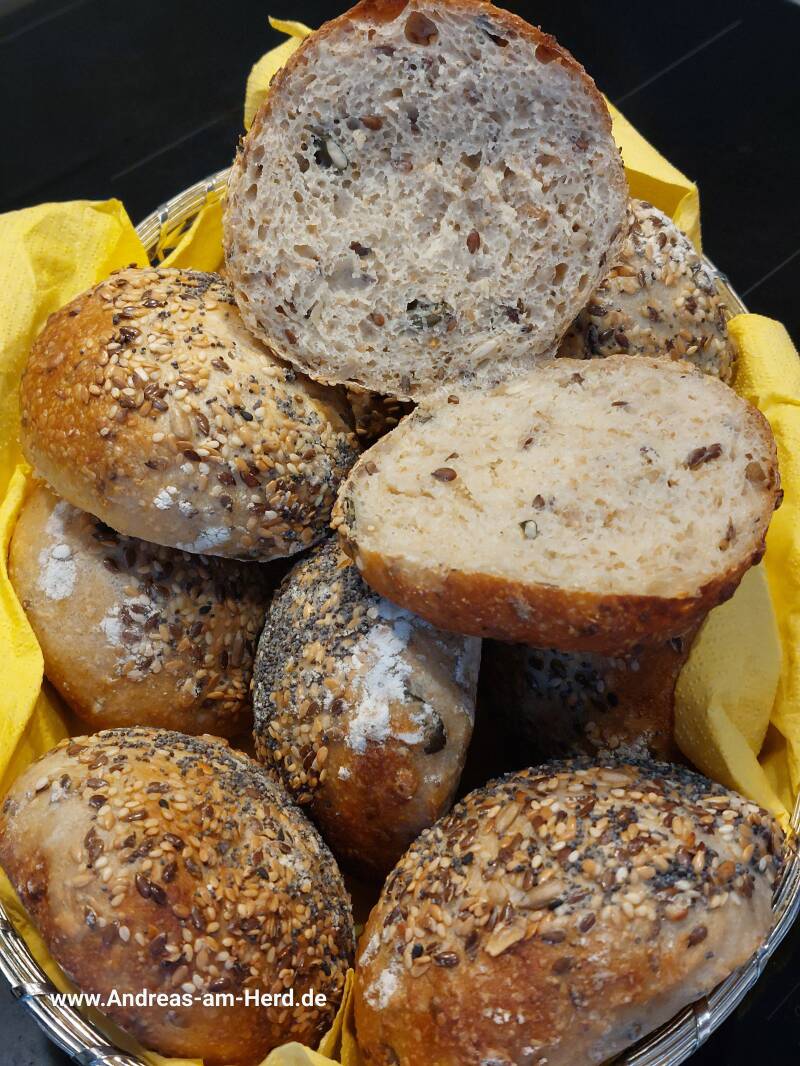
Sourdough:
- 120 g mixed seeds (pumpkin seeds, sunflower seeds, flaxseeds)
- 120 g boiling water
Main dough:
- 50 g Levito Madre (a type of flour)
- 250 g lukewarm water
- 150 g yogurt
Dissolve the Levito Madre in the water and yogurt.
- 600 g Caputo Cuoco wheat flour
- 75 g 5-grain flakes
- 15 g baking malt
Stir everything together until no flour clusters are visible.
Let stand, covered, for 1 hour to autolyse.
- 5 g dried yeast
- 15 g salt
Knead everything for about 15 minutes, then knead in the cooled mixed seeds.
Place the dough in an oiled dough pan and stretch and fold.
Let the dough rest for 2 hours, stretching and folding every 30 minutes.
Then Store in the refrigerator overnight.
Remove from the refrigerator the next morning and let it acclimatize for 1 hour, stretching and folding every 30 minutes.
Place the dough on a well-floured work surface, flatten slightly, and shape into a rectangle.
Cut off pieces and press them into a grain mixture. Place on a baking sheet lined with parchment paper, cover, and let rise for 45 minutes with the seam facing up.
Meanwhile, preheat the oven to 250°C.
Place the rolls in the oven. Reduce the temperature to 230°C.
Bake with plenty of steam for about 15 minutes, until the rolls are nice and crispy and have the desired brown color.
Power Seed Rolls

In the evening, approximately 12 to 18 hours, before baking
Sourdough starter
- 50 g Levito madre
- 100 g water
- 130 g 550 grade wheat flour
Pre-dough
- 100 g rye flour
- 1 g dry yeast
- 7 g honey
- 100 g water
The next day
For the main dough:
- 240 g wheat flour
- 130 g whole grain flower
- 10 g baking enzymes
- 70 g cold Water
- 60 g Milk
- 1 egg yolk
- 14 g salt
- 7 g dry yeast
- 25 g Beetroot syrup
Knead the three pre-doughs with the above ingredients into a relatively soft dough.
Shortly before the end of the kneading time, knead in the butter. Once this is done, add the remaining ingredients:
- 30 g butter
- 125 g grated carrots
- 50 g pumpkin seeds
- 50 g flaxseeds
Now place the dough in a lightly oiled dough pan and let it rest for about 2 hours, stretching and folding it every 30 minutes.
Then shape the dough into round pieces of about 115 g,
lightly moisten the surface and press into the seed mixture (sesame/flaxseeds).
Place the dough seed-side down on a well-floured baking sheet.
Let the dough rest for 45 minutes. In the meantime, preheat the oven to 250°C.
Now carefully turn the rolls over and place them on a baking sheet lined with parchment paper.
Place the baking tray in the oven with plenty of steam.
Reduce the temperature to 210°C and bake for about 30 minutes.
Ricotta, Bacon, and Onion Rolls
Wonderful, fluffy rolls with a wonderfully balanced, light flavor of onions and bacon on one side and ricotta and sourdough on the other. This recipe is freely adapted from Marcel Paa's recipe, with slight modifications by me.
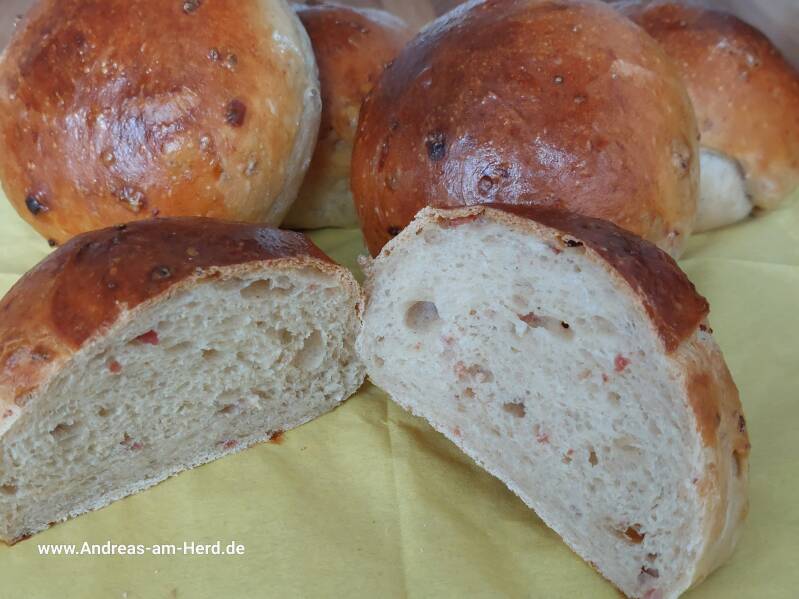
Sourdough (the night before)
- 30 g Levito Mama (Mama flour)
- 60 g water
- 100 g 550 wheat flour (I used Caputo Cuoco)
Main dough
- Sourdough
- 425 g 550 wheat flour (I used Caputo Cuoco)
- 210 g cold water
- 100 g ricotta cheese
- 1 large egg yolk
- 10 g salt
- 6 g dried yeast
- 12 g malted flour
- 150 g bacon
- 50 g onions
for brushing
- 1 egg
- A little milk
- 1 g salt
Dice the bacon and onions and fry them in a pan. Set aside and let cool.
Meanwhile, knead the remaining ingredients into a soft, not very sticky dough. Finally, knead in the cooled bacon and onions.
Kneading time: approx. 12 minutes.
Transfer the dough to a lightly oiled baking pan. Let it rise for 60 minutes, stretching and folding twice.
Transfer the dough to a floured work surface and divide it into 9 equal pieces. Roll it into a round shape and place it on a baking sheet, seam-down. Brush with the frosting and let it rise for 90 minutes.
Meanwhile, preheat the oven to 230°C.
Brush the rolls again with the frosting before placing them in the oven. After placing them in the oven, reduce the temperature to 210°C.
After 5 minutes, add a cup of water to the oven to create steam. Continue baking for another 15-20 minutes, or until golden brown.
Danish Sesame Seed Rolls
I call these sesame seed rolls "Danish" because I made and baked them with Danish flour on my last vacation in Denmark. I think they turned out quite well and I'll definitely bake them more often.
They're quick, ready in just a few hours.
And yes, I'm the kind of person who bakes my own bread/rolls even on vacation*.
*(When we're renting a vacation home)

Ingredients:
- 500 g 550 wheat flour
- 50 g 997 rye flour
- 50 g Levito Mamma flour
- 6 g dried yeast
- 6 g honey
- 14 g baking malt
- 14 g salt
- 1 egg
- 180 g cold water
- 85 g whole milk
- 30 g butter
- sesame seeds
Knead all ingredients except the butter and salt into a smooth, soft dough. Shortly before the end of the kneading time, knead in the salt and butter.
Place the dough in a lightly oiled baking pan. Let it rest at room temperature for about 2 hours. Stretch and fold it 2-3 times.
Then place the dough on a lightly floured work surface and divide it into 9 pieces. First, form them into rounds, then into long shapes. Moisten the dough pieces and roll them in sesame seeds.
Place them in a floured baking cloth, bottom side up, and let rise for another 45 minutes.
Meanwhile, preheat the oven to 250°C.
Place the rolls in the oven, apply steam, and then reduce the temperature to 210°C. Bake for about 18 minutes.
The best hot dog buns (that I know)
These are truly, without exaggeration, the best hot dog buns I've ever eaten. Soft, fluffy, and slightly sweet. Simply wonderful. If you don't like them, I don't think anyone can help you :-)
I also use the same recipe for my hamburger buns and milk rolls.
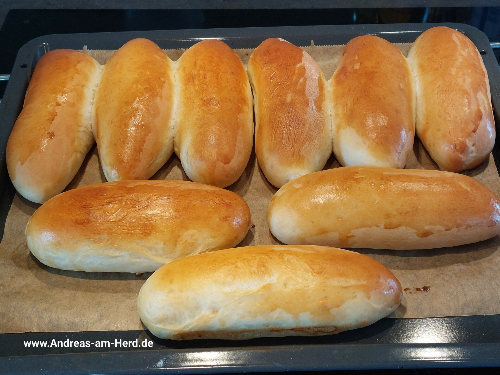
Ingredients:
- 500 g 550 wheat flour
- 330 g cold milk
- 30 g Levito Madre
- 6 g dried yeast
- 10 g baking enzymes
- 12 g salt
- 15 g sugar
- 60 g softened butter
Icing: 1 egg and a little milk
Knead all ingredients into a soft, non-sticky dough.
Place the dough in a lightly oiled dough bowl and let it rise for 90 to 120 minutes. Stretch and fold it 2-3 times.
Then, on a lightly floured surface, divide the dough into 9 pieces, each just over 100 g in weight. First, roll them into rounds, let them relax a little (about 10 minutes), and then let the dough stretch. Place the dough pieces on a baking sheet lined with parchment paper and brush with the egg mixture.
The dough rests for another 45 minutes.
In the meantime, preheat the oven to 190°C.
Brush the dough pieces again with the icing and place them in the oven.
Bake for approximately 18 minutes. Bake without steam for the first 4 minutes to prevent the icing from being washed off by the steam. After 4 minutes, steam the oven thoroughly and bake until the desired browning is achieved.
My special thanks go to Marcel Paa, my unknown "friend" from Switzerland, who created this recipe with a slight modification of my own.
Erstelle deine eigene Website mit Webador